

Low Cost OEM Castings Without Quality Compromise
A casting that is cheap on the purchase order but fails during machining, assembly or service is not a low-cost component. For industrial buyers, low cost OEM castings must mean a lower total landed cost while retaining the alloy control, dimensional consistency and delivery discipline required by the finished product.
That distinction matters in valves, pump bodies, pipe fittings, water-meter components, fire protection equipment and machinery. A small variation in wall thickness, thread allowance, porosity or material composition can lead to rejected batches, delayed builds and warranty exposure. The right sourcing approach reduces manufacturing cost without moving those risks into your operation.
What low cost OEM castings should mean
The unit price is only one part of the commercial decision. Procurement teams should assess the full cost of producing a usable part: tooling, material yield, machining allowance, inspection, packing, freight, import handling, scrap risk and the cost of late delivery. A supplier quoting the lowest casting price may not be offering the best manufacturing result if extensive rework or sorting is needed later.
Cost-efficient castings are normally achieved through disciplined production rather than reduced control. High-volume manufacturing spreads tooling costs over more parts. Stable melting practice reduces variation between pours. Purpose-designed moulds and cores reduce unnecessary machining stock. Repeat orders allow a factory to improve cycle times, material recovery and process capability.
For an OEM, this creates a practical advantage. The supplier can offer competitive pricing because the process is efficient, not because the casting specification has been quietly weakened.
Start with the part, volume and process
Casting process selection has a direct effect on price, finish and repeatability. There is no single low-cost method for every brass, bronze or copper alloy component. The correct choice depends on geometry, material grade, annual demand, tolerance requirements and the amount of downstream machining planned.
Sand casting can be commercially effective for larger components, complex internal passages and lower-to-medium production volumes. It offers flexibility in design changes and tooling investment, although surface finish and dimensional variation may require additional machining.
Investment casting may suit smaller, intricate parts where near-net shape reduces machining time. The initial process cost can be higher, but it may provide value when the component has detailed features, difficult profiles or a high cost of machining from a rougher casting.
Permanent mould and other repeatable production methods can improve consistency for established, higher-volume programmes. However, the tooling investment needs to be justified by forecast demand. Buyers should be cautious about specifying a process before discussing the part with the manufacturer. A casting supplier should recommend the route that produces the required result at the required volume, rather than forcing every enquiry into one production method.
Design decisions that reduce cost early
The most valuable savings are often created before tooling is released. Uniform wall sections help metal flow and cooling behaviour. Sensible radii reduce stress concentration and improve mould filling. Clear datum references make machining and inspection more reliable. Removing non-functional detail can shorten both casting and finishing operations.
Machining allowance also deserves close attention. Too little allowance increases the chance of incomplete clean-up. Too much raises material use, cycle time and tool wear. The objective is not the smallest possible casting, but a stable near-net shape that can be machined efficiently into a conforming finished component.
For pressure-bearing valve and pump parts, design reviews should also consider sealing faces, threaded connections, internal flow paths and areas exposed to loading. These details affect whether a lower-cost casting route is genuinely suitable.
Material control cannot be treated as optional
Brass and bronze components are selected for corrosion resistance, machinability, strength, pressure performance and compatibility with the application environment. Material substitution without engineering approval can undermine every one of those requirements.
A dependable supplier controls incoming raw material, melt practice and alloy verification. The expected chemical composition should be agreed before production, especially where the casting will be used in water systems, fire safety equipment, marine conditions or demanding industrial assemblies. Traceability requirements should also be established for the application and order value.
Material control is particularly relevant when comparing quotations from different regions. Lower labour and factory overhead can reduce cost significantly. Lower-grade alloy, uncontrolled recycled feedstock or inconsistent melting practices create a different kind of saving, one that can become expensive once parts reach the assembly line.
Ask the supplier how the specified alloy is verified, what records are available and whether test pieces or batch samples can be provided where required. The level of documentation should match the risk of the part. A simple non-critical fitting does not need the same evidence as a pressure-containing casting, but neither should be produced without a defined material standard.
Quality control should focus on the characteristics that matter
Inspection adds value when it is connected to actual failure risk. A blanket demand for every possible test can increase cost and lead time without improving the part. Conversely, a basic visual check alone is rarely enough for an OEM component with critical interfaces.
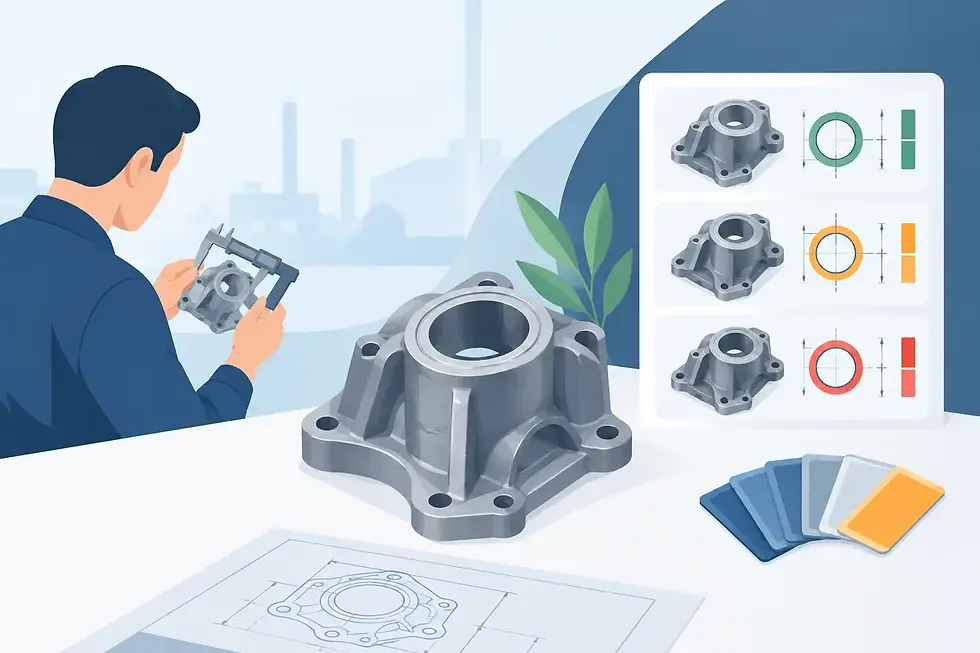
A suitable control plan commonly covers dimensional checks against the approved drawing, visual inspection for surface defects, verification of critical machined features and material confirmation. Depending on the application, it may also include pressure testing, leak testing, hardness checks, section assessment or non-destructive examination.
The key is to define acceptance criteria before the first production run. Drawings should clearly identify critical dimensions, tolerances, threads, sealing surfaces, surface finish requirements and any no-defect zones. If the casting will be machined by a different supplier, agree who owns each tolerance and how parts will be located during machining.
First-article approval is useful for new tooling and custom parts. It gives engineering and procurement teams the opportunity to confirm fit, function and finish before a full batch is made. Once approved, retained samples, controlled drawings and agreed inspection records support repeatability from order to order.
Build supply-chain savings into the quotation
A competitive factory price does not automatically produce a competitive landed cost. Freight mode, packaging density, shipment size, customs classification, payment terms and stock strategy can change the final commercial result.
Vietnam-based production can be attractive for OEM castings where demand is sufficient to support consolidated shipments and planned manufacturing. The benefit is strongest when buyers provide realistic forecasts, avoid frequent last-minute design changes and combine related components into a single sourcing programme.
Local commercial support remains valuable even when manufacturing is offshore. Clear communication on drawings, revisions, samples, shipment status and corrective actions prevents costly misunderstandings. For export buyers, an accessible UK point of contact can help keep technical and commercial decisions moving while production is managed at scale.
Tan Tasa UK combines that customer-facing support with Vietnam-based manufacturing for brass, bronze and copper alloy parts. For buyers, the practical objective is straightforward: access cost-efficient production while retaining clear technical communication and controlled delivery expectations.
What to include in an OEM casting enquiry
A complete request for quotation lets a supplier price the part correctly at the first attempt. It also exposes questions that should be resolved before tooling begins. Include these details where available:
A current drawing, 3D model or approved sample, with revision status clearly shown.
Required alloy grade, product application and any material or compliance requirements.
Annual volume, batch quantity, forecast pattern and target delivery schedule.
Critical dimensions, machining scope, testing requirements, packing needs and destination port.
If a target price is supplied, it should be paired with the expected annual volume and technical requirements. A credible supplier can then identify which changes may reduce cost, such as a revised machining allowance, alternative process, shared tooling approach or more efficient order quantity. Price targets without production assumptions often encourage unrealistic quotations.
Make the first order a controlled production step
For a new supplier or new component, start with a defined approval route rather than treating the first shipment as a routine purchase. Confirm drawings, alloy, tooling ownership, sample requirements, inspection criteria, packaging and lead time in writing. Agree how deviations will be reported and who can approve changes.
Low cost should give your business more room to compete, not more work to manage. The strongest casting programmes are built when engineering, quality and procurement agree the few characteristics that cannot move, then allow the manufacturer to remove cost from everything that can.


Comments