

Vietnam Manufacturing vs China Sourcing for OEMs
A valve body that arrives out of tolerance, a casting with inconsistent porosity, or a late shipment of fittings can stop an assembly line far more quickly than a modest unit-price saving can help it. For industrial buyers, Vietnam manufacturing vs China sourcing is not a simple country comparison. It is a decision about supplier control, engineering support, material consistency, production scale and the real landed cost of keeping products available.
China remains a major global sourcing centre with exceptional breadth. Vietnam has become a serious alternative for buyers who want competitive manufacturing, export-ready production and a more focused supplier relationship. The right choice depends on the component, the volume, the specification and the level of control required after the purchase order is placed.
Vietnam manufacturing vs China sourcing: the commercial difference
China’s principal advantage is depth. Its industrial regions contain extensive networks of foundries, machine shops, plating suppliers, toolmakers, packaging companies and trading businesses. A buyer seeking a highly specialised process, a very broad product range, or rapid access to several competing quotations may find more options in China.
That depth can also create complexity. The same product category may include factories, agents and trading companies with very different technical capability. Identifying who controls the production process, who owns the tooling and who carries responsibility for final inspection takes disciplined supplier qualification. Lower quoted prices do not always reflect the cost of rework, rejected batches, engineering delays or additional third-party inspection.
Vietnam’s advantage is often operational focus. The manufacturing base is well suited to established industrial products, repeat production and OEM components where a supplier can combine casting, machining, assembly and quality control under a defined process. Labour and operating costs can remain competitive, while buyers may find communication and project ownership more direct when working with a manufacturer rather than a layered trading structure.
Neither route is automatically cheaper. China may be highly competitive for mature, high-volume commodity lines supported by local supply chains. Vietnam can provide stronger value where consistent production, responsive technical communication and controlled manufacturing reduce the total cost of supply. Procurement teams should compare landed cost and risk, not only the ex-works figure.
Component capability matters more than country of origin
For brass, bronze and copper alloy parts, the key question is whether the supplier can reliably control the full manufacturing route. A water-meter body, pump fitting, fire hose coupling or precision valve component needs more than a good-looking casting. It requires the correct alloy, stable dimensions, suitable machining allowances, controlled threads, pressure performance where relevant and protection during transport.
China offers a broad selection of brass and bronze suppliers, including specialists able to support complex casting methods, advanced surface finishes and large product portfolios. This is useful where a project needs unusual geometry, multiple secondary processes or access to a specialist material grade. However, the buyer must still verify that samples, pilot batches and serial production are made to the same standard.
Vietnam can be particularly effective for standard and customised components with repeatable production requirements. A capable Vietnam-based manufacturer can provide sand casting, gravity casting, machining, threading, polishing, assembly and packing within a managed production programme. This reduces hand-offs between suppliers and gives the buyer clearer accountability for the finished part.
The technical review should begin with drawings, tolerances, material requirements, annual volume and functional conditions. If a component carries water pressure, operates in corrosive environments or connects to a safety-critical system, specify the relevant testing and inspection requirements before approving a price. Country selection cannot compensate for an incomplete specification.
Quality control should be visible and measurable
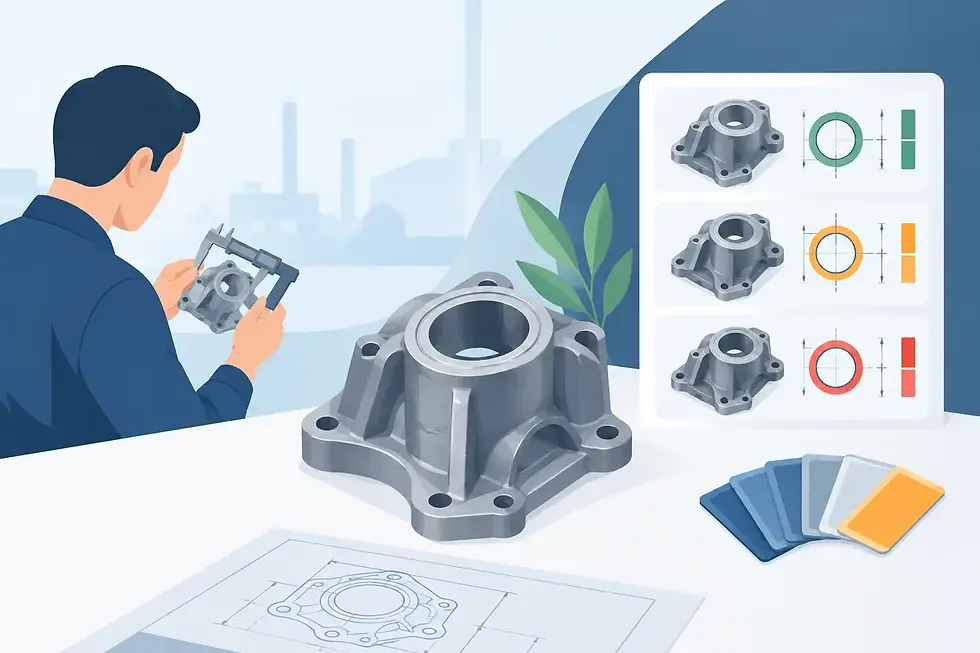
Quality is where industrial sourcing decisions are won or lost. A factory should be able to explain how it verifies incoming raw material, controls moulding or casting, checks critical dimensions during machining and approves finished goods before shipment. Buyers should ask for more than a general statement that quality is checked.
For copper alloy components, inspection commonly needs to address chemical composition, casting integrity, dimensions, threads, surface condition and weight where it affects function or material usage. Depending on the application, pressure testing, leak testing, hardness testing or batch traceability may also be required. The correct inspection plan depends on the part, but the plan must be agreed before production begins.
Chinese manufacturers range from highly sophisticated exporters with well-developed quality systems to smaller workshops with limited documentation. Vietnam has the same variation. The practical difference is not a national standard. It is the individual supplier’s willingness and ability to document controls, manage corrective action and maintain the same process from sample approval to repeat orders.
For this reason, buyers should qualify the factory rather than sourcing solely through catalogue images or a low first quotation. Review production capability, sample parts, inspection records, tooling arrangements and export packing. For larger programmes, an audit or independent inspection can be commercially sensible, especially before approving a new casting supplier.
Lead times and supply-chain resilience
China’s dense domestic supply chain can shorten lead times for materials, tooling and outsourced processes. If a supplier needs a particular insert, fastener, coating or packaging format, it may be available locally with little delay. This is valuable for fast-moving development work and broad product ranges.
Vietnam’s supply chain is developing quickly, but some specialist inputs, machinery parts and raw materials may still be imported. That can add planning requirements, particularly for non-standard alloys or highly specialised finishes. A reliable manufacturer will identify these dependencies early and build them into the production plan rather than treating them as a late exception.
For export buyers, sea freight, port handling, customs clearance and inland delivery often have a greater effect on overall lead time than the difference between two factory locations. The best protection is not simply choosing the nearest source. It is maintaining realistic forecasts, setting reorder points from actual consumption and agreeing production lead times that include inspection and packing.
A supplier with established export procedures should also provide clear documentation, practical packing methods and communication that does not disappear once goods leave the factory. For heavy brass and bronze products, packing quality matters. Damaged threads, mixed batches and inadequate palletisation create avoidable cost at the receiving end.
Cost comparisons need a wider view
A lower unit price can be genuine, but it is not the full commercial picture. Buyers should compare the total cost of ownership across the life of the programme. This includes tooling, sample development, scrap risk, inspection, freight, duties, payment terms, stockholding and the cost of delayed or non-conforming production.
Vietnam manufacturing can be attractive when a buyer needs competitive labour-intensive machining or assembly alongside controlled, high-volume casting. It can also be a practical route for companies looking to diversify geographic exposure without moving every product line at once. A phased approach often works well: qualify a Vietnam supplier on standard fittings or repeat components first, then extend to custom OEM parts after performance is proven.
China sourcing may remain the better choice where a supplier already has proven tooling, established material availability and exceptional scale for a specific item. Changing country simply because it is fashionable can introduce unnecessary qualification cost. The objective is a dependable supply programme, not diversification for its own sake.
Choosing the right sourcing model
The decision should start with the product family. Commodity parts with limited customisation may suit a broad China sourcing exercise, particularly when several established suppliers can quote against the same standard. Bespoke valve bodies, bronze castings and machined mechanical components often benefit from a direct manufacturing relationship where engineers and procurement teams can resolve drawings, tolerances and production issues quickly.
Ask each prospective supplier how it will manage material sourcing, tooling, first article approval, in-process checks, final inspection and replacement of non-conforming goods. Their response will reveal more than a percentage price difference. Clear answers, supported by records and samples, are usually a better indicator of future performance than ambitious lead-time promises.
Tan Tasa UK reflects the hybrid model that many industrial buyers now require: accessible commercial communication supported by Vietnam-based manufacturing for brass, bronze and custom mechanical components. For buyers, the value lies in having a defined point of contact while retaining the cost efficiency of export-scale production.
The strongest sourcing decision is the one that leaves your production team with fewer surprises. Put the drawing, material standard, inspection criteria and delivery expectation on the table early, then choose the manufacturing partner that can meet them repeatedly.


Comments