
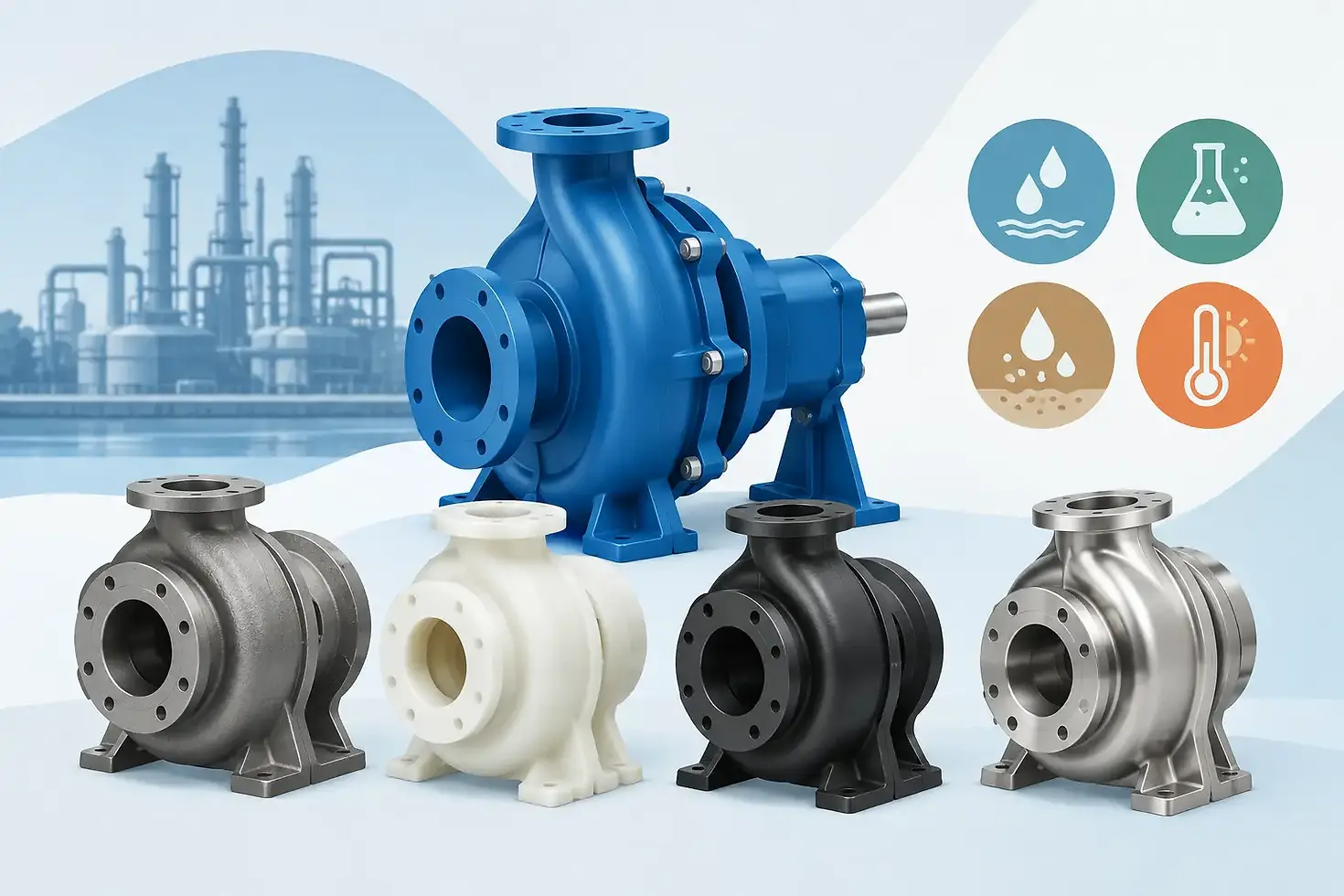
Pump Housing Materials for Demanding Service
A pump housing is more than an outer shell. It contains pressure, directs flow, supports internal components and often determines how well a pump withstands corrosion, abrasion and repeated thermal cycling. Selecting the right pump housing materials is therefore a commercial and engineering decision: the lowest initial casting price can become costly if the housing fails early, requires frequent maintenance or restricts the pump’s operating range.
For OEMs, distributors and procurement teams, the most effective choice starts with the pumped medium and duty conditions, then considers manufacturing method, machining requirements, volume and total service cost. There is no universal best material. There is, however, a clear way to narrow the options.
What a Pump Housing Must Withstand
The housing carries the pressure generated by the pump and must retain its dimensional stability around seals, bearing supports, fasteners and inlet and outlet connections. Its material must also tolerate the fluid itself. Clean potable water, seawater, glycol mixtures, wastewater, oils and chemical solutions place very different demands on a casting.
Pressure and temperature matter, but they are not the only variables. Suspended solids can erode internal passages. Chlorides can accelerate corrosion. Frequent starts and stops create fatigue loading. Outdoor installation introduces condensation and environmental corrosion. A housing that performs well in a clean, ambient-temperature water application may be unsuitable for a hot, abrasive or saline process.
Material selection should also account for the way the part will be made. A complex volute, thin-wall design or housing with multiple threaded ports needs a material and foundry process capable of producing consistent wall thickness, sound metal and reliable machining allowances. This is particularly relevant where an OEM requires repeatable performance across larger production runs.
Common Pump Housing Materials
Cast iron
Cast iron remains a widely used option for general water handling, heating systems, agricultural pumps and many industrial duties. It offers good castability, reasonable wear resistance and an attractive cost position for high-volume production. Its stiffness also helps maintain geometry under normal operating loads.
Its limitation is corrosion resistance. Untreated cast iron is not a strong choice for corrosive liquids, saline environments or applications where appearance and long-term external protection are priorities. Coatings can extend its useful life, but a coating should be treated as part of the specification, not as an afterthought. Buyers should define coating type, preparation standard, thickness and inspection requirements.
Ductile iron
Ductile iron provides higher strength and improved impact resistance compared with conventional grey cast iron. It is often selected where the pump housing requires more mechanical margin, such as higher-pressure water systems, larger units or installations exposed to handling loads and vibration.
It retains the cost advantages associated with ferrous castings, although corrosion protection is still necessary in many wet or external environments. Ductile iron can be an efficient middle ground when strength is the main upgrade required and stainless steel would add unnecessary cost.
Bronze and brass alloys
Bronze and brass are established choices for water-related equipment, valve bodies, marine-adjacent applications and smaller precision pump components. Copper alloys offer useful corrosion resistance, good machinability and reliable performance in many clean-water services. They are particularly practical where the housing includes threaded connections, close-tolerance seal seats or integrated features that need accurate machining.
The exact alloy is critical. Brass is not one material category with identical behaviour across every application, and bronze grades vary in strength, corrosion resistance and casting performance. Dezincification resistance may be required for certain brass components exposed to aggressive water conditions. For saltwater, chemical exposure or higher wear, an engineering review may point towards a more suitable bronze grade or another alloy entirely.
For OEM sourcing, copper alloy housings can offer a strong balance of durability, production accuracy and finished appearance. They also suit custom casting programmes where the same supplier can control casting, machining, threading and final inspection.
Stainless steel
Stainless steel is commonly specified for corrosive fluids, hygienic duties, food processing, chemical handling and demanding water applications. It provides strong corrosion resistance when the grade is matched to the medium and environment. It can also deliver a clean finish where external appearance is relevant.
However, stainless steel is not automatically corrosion-proof. Chloride concentration, temperature, oxygen levels and crevice conditions can all affect its performance. Grade selection should be based on the actual process fluid rather than a broad assumption that any stainless grade will be adequate. Stainless housings also typically carry higher material, casting and machining costs than iron or standard copper alloys.
Aluminium alloys
Aluminium is useful where weight reduction is a priority, particularly in portable equipment, automotive systems and compact machinery. It casts well in many forms and can reduce handling and transport weight. For appropriate fluids, it can be a cost-effective route to a light, functional housing.
Its chemical compatibility is narrower than many buyers assume. Certain alkaline solutions, acidic fluids and galvanic combinations can cause rapid degradation. Aluminium also needs careful design around threaded connections and wear surfaces. It is best specified where low mass delivers a clear product benefit and the liquid environment is well controlled.
Engineering plastics and composite materials
Thermoplastics such as polypropylene, PVC, PVDF and reinforced polymers are used in chemical transfer, water treatment and applications requiring resistance to specific corrosive media. They do not rust, can be economical at volume and may simplify moulded geometry.
Their trade-off is mechanical and thermal capability. Pressure limits, temperature limits, creep, UV exposure and impact resistance must be assessed carefully. Plastics are not a direct replacement for metal housings in every duty. They are a specialised solution when chemical compatibility and low weight outweigh the need for high structural strength or high-temperature performance.
Selecting Pump Housing Materials by Duty
A practical specification begins with facts rather than a preferred alloy. Define the fluid, concentration, solids content, operating temperature, maximum pressure, expected flow range and installation environment. Include abnormal conditions where relevant, such as dry running, pressure spikes, frost exposure or cleaning chemicals.
For clean-water circulation and standard utility service, cast iron or ductile iron may provide the required life at the most competitive cost. If corrosion resistance and machined precision are more important, a suitable brass or bronze casting may be the better fit. For aggressive chemical media, carefully selected stainless steel or engineered polymers are more likely to justify their higher initial cost.
Wear is often overlooked. In slurry, sediment-laden water or wastewater applications, a corrosion-resistant material may still fail if it lacks abrasion resistance. Internal geometry, flow velocity and impeller clearance matter alongside material grade. Harder alloys, protective linings or a revised hydraulic design may be needed where solids are the principal cause of damage.
Manufacturing Detail Affects Performance
Material grade alone does not guarantee a dependable housing. Porosity, shrinkage cavities, inconsistent wall sections and poor machining can compromise pressure containment and sealing performance. The production route must be controlled from pattern design and melting practice through to machining and final inspection.
For cast housings, buyers should confirm the agreed chemical composition, mechanical properties where applicable, dimensional tolerances, pressure-test requirements and surface finish expectations. Thread specifications, flange faces, seal bores and mounting features deserve particular attention because these are the areas most likely to create assembly problems downstream.
A capable supplier can also advise whether a design is practical to cast at scale. Small changes - adding appropriate radii, balancing wall thickness or revising a difficult core feature - can reduce rejection rates and machining time without changing the pump’s function. This is where early collaboration between the OEM engineer and manufacturer protects both quality and unit cost.
Cost Should Be Measured Over Service Life
A lower-cost housing may be the right commercial choice when the duty is mild, replacement is straightforward and volumes are high. Over-specifying every pump with premium stainless steel can unnecessarily increase material cost, machining time and lead time. Equally, using a basic iron casting in a corrosive application can create warranty claims, field failures and reputational damage.
The useful comparison is total cost: unit price, tooling, finishing, machining, inspection, assembly yield, expected maintenance and replacement risk. For custom programmes, consider the supplier’s ability to maintain alloy consistency and dimensional control from the first samples through repeat orders. A low quotation has limited value if it cannot be repeated reliably at production volume.
Tan Tasa UK supports OEM and industrial buyers with brass, bronze and copper alloy castings manufactured for standard and custom component requirements. For pump housings, the strongest result comes from supplying a complete technical brief early - including drawings, material preference, operating conditions, critical dimensions and forecast quantities. That gives the manufacturing team the information needed to recommend a practical, cost-conscious route to production.
The right housing material is the one that meets the real duty without paying for performance the application will never use. Specify the operating conditions clearly, test critical assumptions before volume release and treat casting quality as part of the material decision. That approach produces pumps that are easier to manufacture, more dependable in service and more competitive to source.


Comments