

High Volume Brass Component Production at Scale
A brass component that performs well in a first-off sample can still become a costly supply problem at 50,000 units. Tool wear, material variation, cycle-time pressure and inconsistent inspection can all affect fit, sealing performance and assembly efficiency. High volume brass component production therefore depends on more than machining capacity. It requires controlled processes that keep every production batch aligned with the approved specification.
For OEMs, distributors and industrial buyers, the objective is straightforward: receive components that meet drawing requirements, arrive when required and support a competitive finished-product cost. The supplier’s real value is shown in how reliably it manages that objective over repeat orders, not simply in the unit price quoted for the first batch.
What high-volume production demands
Brass is widely used for valves, fittings, water-metering parts, pump components, fire-protection products, electrical fittings and mechanical assemblies because it machines efficiently, resists corrosion in many service environments and can hold detailed features. These advantages make it suitable for volume manufacture, but they do not remove the need for process discipline.
At higher quantities, a small variation becomes a repeated issue. A thread that is slightly tight can slow every assembly operation. A bore that drifts towards a tolerance limit can affect flow, sealing or mating-part fit. Poorly controlled surface finish may create leakage paths or lead to unacceptable cosmetic variation on customer-facing equipment.
The production route must be matched to the part. A simple threaded fitting may be efficiently made from brass bar using automatic turning and secondary operations. A more complex valve body or shaped component may be better suited to forging, casting and subsequent precision machining. The correct route depends on annual volume, geometry, material grade, critical dimensions, finishing requirements and tooling investment.
Buyers should be cautious of a one-process approach. The lowest piece price is not always the lowest total cost if it creates excessive scrap, limits dimensional control or introduces avoidable secondary operations. A capable manufacturer reviews the drawing and volume forecast before committing to the production method.
From drawing review to repeatable output
Production consistency begins before material reaches a machine. The drawing should identify critical dimensions, thread standards, tolerances, surface requirements, material specification and any functional tests. Where the application involves pressure, potable water, fire safety or a specific customer approval, these requirements need to be agreed early rather than added after sampling.
A practical technical review also considers manufacturability. Tight tolerances should be retained where they affect function, but applying them across non-critical features raises machining time and inspection cost without improving the finished product. Similarly, sharp internal corners, difficult tool access or unnecessary finishing requirements may be adjusted where design intent permits.
Once the specification is agreed, the supplier should establish a controlled route that covers material procurement, tooling, machining or forming, deburring, cleaning, inspection, packing and despatch. The point is not to create paperwork for its own sake. It is to ensure that operators, inspectors and production planners are working to the same approved requirements.
First-article approval is particularly useful for custom OEM work. It confirms that the part, gauges, thread forms and functional requirements are understood before a full run begins. For repeat components, retained samples and documented settings help reduce set-up variation between batches.
Material choice affects cost and performance
Not all brass grades behave the same way in production or service. The selected alloy can influence machinability, corrosion resistance, strength, forging response and suitability for regulated applications. The material choice must suit the operating environment as well as the manufacturing route.
For example, a water-system component may require a specified low-lead alloy or a grade selected for corrosion performance. A machined electrical part may prioritise conductivity and precision. A high-stress mechanical component may need a different copper alloy altogether. Substituting material solely to reduce price can create compliance, durability and traceability risks.
Material control should include confirmed grade, supplier traceability where required and checks that prevent mixed stock entering production. This is especially relevant where visually similar alloys are held in the same facility. Consistent raw material is the foundation for consistent machining, surface finish and final performance.
The controls that protect volume orders
High-volume brass component production needs inspection at the points where variation can be introduced, rather than relying only on a final check. Final inspection remains necessary, but it cannot efficiently recover a batch that has been produced outside specification.
Effective controls normally include:
Incoming checks on brass bar, castings or forgings against the agreed material requirements.
First-off inspection after machine set-up, including critical dimensions, threads and visual condition.
In-process checks at planned intervals to identify tool wear or set-up drift before it affects a larger quantity.
Final sampling and functional testing where the component’s application requires it, such as pressure, leakage or assembly checks.
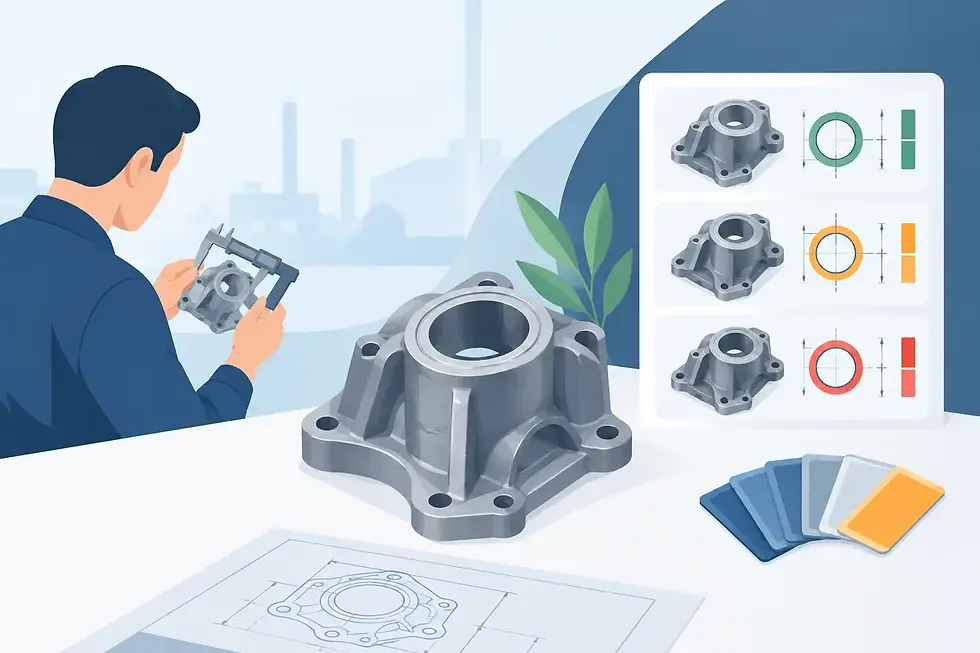
Measurement methods must be appropriate to the tolerance and feature. Thread gauges, plug gauges, callipers, micrometres, bore gauges and dedicated fixtures all have a role. For critical parts, relying on a general visual judgement is not sufficient. Clear acceptance criteria allow inspection staff to make consistent decisions and provide buyers with confidence that the same standard applies across shipments.
Tool management is equally important. Brass is generally machinable, but tools still wear, chips can affect finishes and long unattended runs require stable cutting conditions. Scheduled tool changes, controlled feeds and speeds, and machine maintenance protect both output rate and dimensional stability. The target is predictable production, not simply maximum machine speed.
Capacity should include planning, not just machines
A supplier may have many machines but still struggle to support a demanding programme if it lacks planning discipline. Capacity for industrial buyers means the ability to reserve production time, manage raw-material supply, maintain tooling, process secondary work and pack goods for export without disrupting confirmed deliveries.
Forecasts are valuable, even when they are not firm purchase orders. A rolling forecast helps the manufacturer plan brass stock, tooling life and machine availability. It can also reduce the risk of long lead times when customer demand rises. For parts with seasonal demand, such as irrigation, heating or fire-protection equipment, this planning can be decisive.
Batch size also involves a trade-off. Larger runs can reduce set-up cost and improve unit pricing, but they increase inventory exposure and may tie up cash. Smaller batches offer more flexibility but can carry a higher cost per part. The right arrangement depends on consumption rate, storage capacity, component value and the buyer’s supply-chain policy.
For export programmes, packing is part of production quality. Brass parts must be protected from transit damage, contamination and excessive movement in cartons or pallets. Clear labelling, batch identification and accurate quantities reduce receiving delays at the customer’s facility. A component that arrives mixed, damaged or difficult to identify creates unnecessary cost regardless of how accurately it was manufactured.
Evaluating a supplier for high-volume brass work
Procurement teams should assess more than quoted unit price. The useful question is whether the supplier can continue meeting the requirement after the sample stage, during demand peaks and when a corrective action is needed.
Ask how the supplier manages tooling changes, material traceability and in-process inspection. Confirm its experience with the relevant product type, whether it can support custom drawings alongside standard components, and how it communicates production status. For components used in safety-critical or regulated applications, clarify test requirements and documentation before placing the order.
Commercially, a manufacturer with efficient offshore production can offer significant savings, but accessibility still matters. A local commercial contact can shorten approval cycles, clarify specifications and provide a direct route for order queries. This combination is particularly useful where buyers need cost-efficient manufacturing without losing responsive communication.
Tan Tasa UK combines UK customer support with Vietnam-based production for brass, bronze and copper-alloy components, helping customers balance cost, technical control and scalable supply. The strongest sourcing relationships are built around accurate specifications, realistic forecasts and a shared commitment to preventing quality issues before parts reach the assembly line.
When volume demand is growing, the right manufacturing partner does not simply promise capacity. It establishes a production route that can be repeated, inspected and improved with every order.


Comments