

Fire Protection Casting Supply Chain Priorities
A sprinkler valve body or hose coupling is a small part of a much larger safety system, but a late, inconsistent or incorrectly specified casting can hold up an entire installation. A dependable fire protection casting supply chain therefore needs more than a competitive unit price. It requires material control, repeatable production, clear documentation and realistic planning from enquiry through to delivery.
For OEMs, distributors and system manufacturers, the objective is straightforward: secure cast components that meet the required specification, arrive when promised and remain commercially viable as volumes increase. The difficult part is that these requirements are closely connected. A change in alloy, tooling, inspection level or shipment plan can affect cost, lead time and performance at the same time.
Fire Protection Casting Supply Chain Priorities
Fire protection equipment operates under high consequences. Castings used in sprinkler systems, hydrant fittings, fire hose connections, valves, pump assemblies and pipework accessories must withstand pressure, corrosion exposure, installation forces and long service periods. The casting is not simply a commodity part. Its dimensional accuracy and material integrity influence the machining process, assembly fit and final product reliability.
Buyers should begin by separating critical requirements from preferences. The drawing and purchase specification should define the alloy grade, applicable dimensions, thread or connection requirements, pressure expectations, surface finish, machining allowance and any inspection criteria. Where a part is intended for a certified assembly, the supplier also needs to understand the approved configuration and change-control restrictions.
This avoids a common sourcing failure: requesting a quotation against an incomplete drawing, then discovering later that the quoted process does not include a required test, traceability record or machining feature. A low initial price can disappear quickly when these items are added after tooling has begun.
Material selection must reflect the application
Brass, bronze and other copper alloys are widely used for fire protection components because they offer useful corrosion resistance, machinability and durability. However, the correct material depends on the product design, water conditions, environment, required mechanical properties and the standards governing the finished equipment.
A casting supplier should work to the specified alloy rather than substitute a nominally similar grade for convenience. Two materials may look alike in the finished part while behaving differently during machining, pressure testing or prolonged exposure. Chemical composition control and heat identification matter, particularly where a customer requires certificates or a defined traceability route.
It also pays to assess the casting design itself. Sections that are too thin, sharp internal transitions and insufficient draft can increase the risk of porosity, shrinkage or distortion. A capable manufacturer can advise on manufacturability before production, helping customers protect the functional geometry without creating avoidable scrap or cost.
Build Quality Control Into the Casting Process
Inspection at final dispatch is necessary, but it cannot correct poor process control earlier in production. Quality begins with approved raw material, controlled melting, mould preparation and repeatable pouring practice. It continues through fettling, machining, testing and packing.
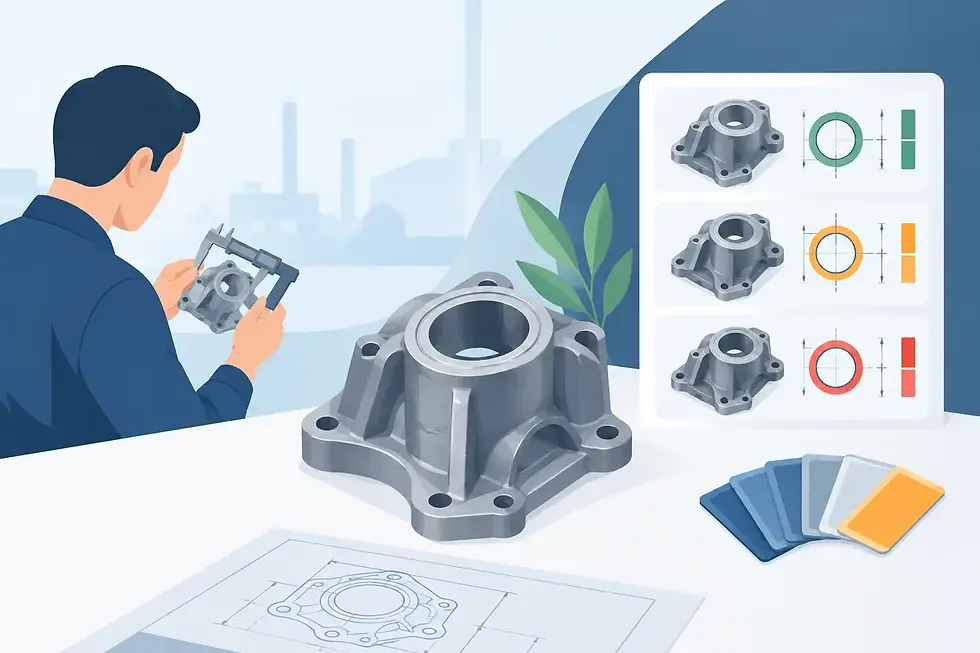
For buyers, the most useful question is not simply whether a factory performs inspection. It is what the factory checks, when it checks it and how non-conforming parts are handled. The appropriate controls depend on the component. A simple non-pressure fitting may need dimensional sampling and visual examination, while a pressure-retaining valve body may require additional checks defined by the customer or product approval route.
A practical quality plan normally addresses four areas:
material verification and batch identification;
dimensional checks against approved drawings and gauges;
visual assessment for casting defects, finish and machining quality;
records for agreed tests, inspection results and corrective actions.
The depth of documentation should match the commercial and technical risk. Full batch records may be justified for a critical OEM component, whereas a standard catalogue fitting may operate under a defined sampling plan. Treating every part identically raises costs without necessarily improving control. Treating every part as low risk creates exposure where it matters most.
Approval samples prevent expensive misunderstandings
New tooling and custom castings should move through a structured first-article stage before full production. This is the point to confirm dimensions, machining references, thread engagement, assembly fit, finish and packaging requirements. If the part is subject to customer testing, align the sample quantity and test method before the factory schedules the run.
Approval is especially valuable when drawings have been revised, a tool has been refurbished or production has moved between sites. It establishes a clear reference standard for future inspections. It also gives procurement and engineering teams a documented basis for approving repeat orders rather than relying on assumptions made months earlier.
Lead Time Is a Production Decision, Not a Promise
Fire protection projects often carry fixed installation dates. Yet component lead time is shaped by several real constraints: pattern or die preparation, raw-material availability, melting capacity, machining load, inspection, packing, export documentation and sea or air freight. A supplier that quotes an attractive lead time without breaking down these stages may be creating risk rather than reducing it.
For established parts, the best approach is usually a rolling forecast with agreed call-off quantities. Forecast visibility allows the manufacturer to reserve material and production capacity, while the buyer avoids carrying unnecessary finished stock. For project-driven demand, production should be planned backwards from the required delivery date, including a sensible allowance for first-off approval and transport variation.
Air freight can protect an urgent shortage, but it is rarely the most economical long-term answer for heavy brass or bronze components. Sea freight is normally more suitable for planned volume orders, provided packaging and container planning are handled properly. The right choice depends on weight, order value, installation urgency and the cost of a line stoppage.
Stock strategy should reflect part criticality
Not every casting needs the same inventory policy. High-running standard fittings may justify buffer stock at the distributor or assembly site. Custom parts with limited demand are often better managed through forecasted production slots or a small agreed safety quantity. Slow-moving parts should not be produced in large batches solely because the unit price looks lower.
The key measure is total supply cost: purchase price, freight, stockholding, obsolescence risk, production disruption and administration. A slightly higher unit cost can be the better commercial outcome if it reduces defects, emergency freight and downtime.
Manage Suppliers as Manufacturing Partners
A fire protection casting supply chain becomes more reliable when commercial and technical communication are joined up. Procurement teams need accurate quotations and delivery updates. Engineers need direct answers about tolerances, tooling, alloy selection and machining feasibility. Operations teams need packing specifications, labelling consistency and shipment readiness confirmed before collection.
This is where a supplier with both engineering access and export experience adds practical value. The factory should be able to clarify technical details quickly, while the commercial contact should provide clear order status and prevent avoidable handovers. Time-zone differences are manageable when responsibilities, drawing revisions and approval points are controlled from the start.
Buyers should also assess capacity honestly. A small supplier may be suitable for prototypes and specialist batches but struggle when a distributor requires regular container-scale volumes. Conversely, a high-volume factory may be inefficient for very small, frequently changing orders. There is no single correct model. The right supplier depends on the part range, annual demand, required flexibility and level of engineering support.
Reduce Risk Before It Reaches Site
The strongest supply chains make issues visible early. Use controlled drawings with revision numbers, confirm inspection requirements in the purchase order and agree who has authority to approve changes. If a substitute material, process adjustment or tooling repair is proposed, it should be reviewed before parts are made, not after they arrive at a warehouse.
Packaging deserves the same discipline. Copper alloy castings can be damaged by poor stacking, inadequate separation or movement during transit. Threaded and machined surfaces need appropriate protection, while labels should allow receiving teams to identify part number, batch and quantity without opening every carton. These details reduce receiving delays and prevent otherwise good parts being rejected on arrival.
For international supply, allow time for commercial invoices, packing lists, country-of-origin information and any agreed inspection documents. These are routine requirements, but incomplete paperwork can delay a shipment just as effectively as a production fault.
A dependable supplier relationship is built on measurable performance rather than broad assurances. Monitor on-time delivery, acceptance rate, response time to technical queries and corrective-action follow-through. Review patterns, not isolated incidents. One delayed shipment may be explainable; repeated uncertainty around the same process needs action.
For buyers sourcing brass, bronze and copper alloy components at scale, Tan Tasa UK combines accessible commercial support with Vietnam-based manufacturing capacity. The practical value lies in aligning specification, production control and delivery planning before volume orders begin. When those disciplines are in place, cast components stop being a recurring procurement risk and become a predictable part of the programme.


Comments