

Custom Brass Valve Parts That Fit the Job
When a valve assembly fails in service, the issue is often not the valve body itself. It is the stem that wears too quickly, the seat that does not hold tolerance, or the threaded connector that creates repeat leakage under pressure. That is why custom brass valve parts matter to OEMs and industrial buyers. The right component design can reduce assembly issues, improve service life and lower total procurement cost across an entire production run.
For buyers in water systems, fire protection, pumps and general industrial equipment, off-the-shelf parts are not always the most economical option. Standard components can work well for standard applications, but they often force compromises in geometry, thread form, wall thickness or alloy selection. Those compromises show up later as fitting problems, excess machining, inconsistent performance or avoidable field failures.
Where custom brass valve parts make commercial sense
Customisation is usually justified when the part has a direct effect on sealing, flow control, installation time or product compatibility. That includes valve stems, seats, bonnets, unions, threaded connectors, adaptors and other machined or cast brass components that sit within a larger assembly.
In practical terms, custom parts make sense when a buyer is trying to match an existing product design, improve manufacturability, replace a difficult legacy component or reduce the cost of a multi-part assembly. A custom part may combine functions that would otherwise require two or three separate pieces. It may also remove unnecessary material or machining steps while keeping the same performance in service.
This is where a manufacturing partner adds value. A supplier should not simply copy a drawing. It should review tolerances, production method, alloy grade and finishing requirements to ensure the part is realistic to manufacture at the required volume and price point.
What buyers should specify before production starts
A brass valve component is only as dependable as the information used to make it. Vague drawings and incomplete specifications usually lead to delays, sampling revisions and preventable quality disputes.
The starting point is the technical drawing, ideally with critical dimensions clearly identified. Beyond that, buyers should define the required brass grade, pressure or service conditions, thread standard, surface finish, leak-tightness expectations and any plating or post-machining operations. If the part interfaces with seals, springs or mating housings, those relationships need to be clear from the outset.
Tolerance is a common area where projects go wrong. Some dimensions need close control because they affect sealing or fit. Others do not. If every feature is held to a tight tolerance without a functional reason, the part cost rises unnecessarily. If tolerances are too loose in the wrong place, the savings disappear in rework and rejection. Good suppliers will challenge the drawing where needed and help align tolerances with actual use.
Material selection also deserves attention. Brass is widely used because it machines well, resists corrosion and performs reliably in many fluid-handling applications. Even so, alloy choice depends on the application. Components used in water metering, pumping systems or fire protection may have different priorities around strength, machinability, dezincification resistance or finishing. The right decision depends on environment, regulatory requirements and target price.
Custom brass valve parts and the production method
The best route to production depends on the part geometry, order quantity and performance requirement. There is no single answer for every component.
For simpler geometries and high repeatability, machining from brass bar can be the right option. It offers accurate dimensions and suits parts with fine threads, internal features or precision sealing surfaces. The trade-off is material waste and cycle time, which can affect cost at higher volumes.
For more complex shapes or larger production runs, casting followed by machining is often more efficient. A near-net casting reduces raw material waste and shortens machining time, especially where the part has contours, cavities or sections that would be inefficient to machine from solid stock. The quality of the casting process matters here. Poorly controlled castings create variation that simply moves cost downstream into machining and inspection.
Forging can also be suitable for certain valve parts where mechanical strength and grain structure are priorities. However, not every part benefits enough from forging to justify tooling and process costs. This is one of those cases where the correct answer depends on application and annual volume rather than theory.
Quality control is not optional
Industrial buyers do not need marketing claims. They need evidence that the supplier can hold dimensions, manage alloy consistency and ship repeatable quality over time.
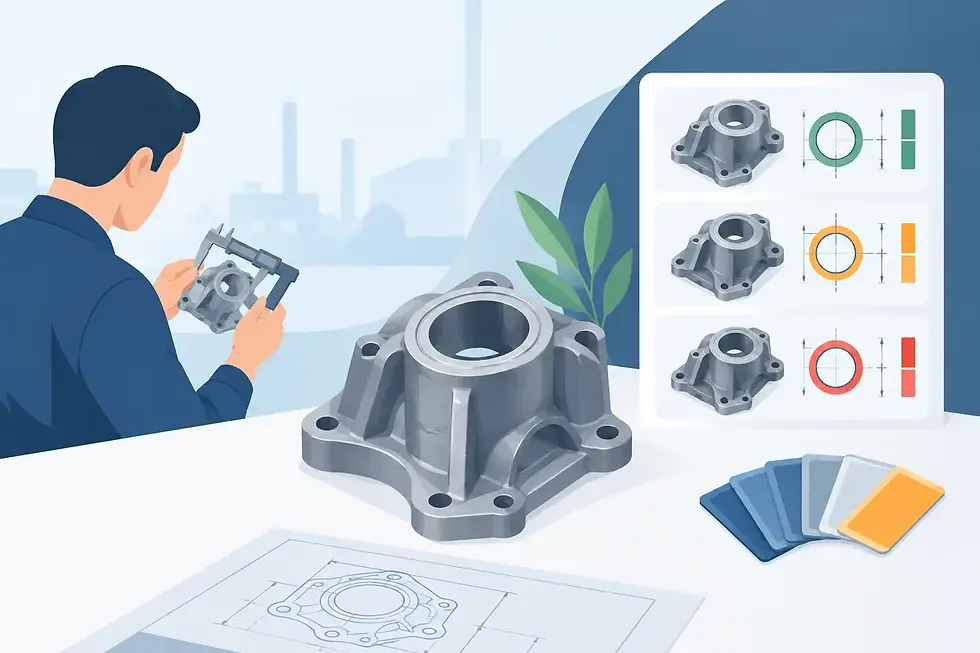
For custom brass valve parts, quality control should begin before full production. That includes drawing review, process planning and first-article approval. Sampling is the stage where dimensions, threads, assembly fit and surface condition can be checked before the order is scaled up. Skipping this step might save a few days, but it tends to create larger delays later.
During production, inspection should focus on critical dimensions and functional characteristics rather than paperwork for its own sake. The point is to control the features that affect assembly and field performance. For valve components, that can include thread accuracy, concentricity, sealing faces, bore finish and material verification.
Consistency matters just as much as one-off accuracy. Many suppliers can produce a good sample. Fewer can maintain the same result across repeat batches and larger volumes. Buyers should look for disciplined process control, documented checks and a clear system for handling non-conformance if it occurs.
Cost savings come from process discipline, not just a lower unit price
A low quoted price can be attractive, but experienced buyers know that the real cost sits across tooling, yield, inspection, freight, delays and field performance. A cheaper part that arrives late, assembles poorly or fails in service is not cheaper at all.
The strongest commercial result usually comes from a supplier that understands both production economics and application risk. That means sensible tooling decisions, stable lead times, efficient machining, proper inspection and realistic communication about what can be achieved at a given price.
This is one reason the hybrid supply model has become more attractive. Buyers want competitive offshore manufacturing, but they also want straightforward communication, clear accountability and fast commercial response. A partner such as Tan Tasa UK can support that requirement by combining UK-side customer access with Vietnam-based production capacity, giving buyers a practical route to lower manufacturing cost without losing control of specifications or order handling.
What OEMs and procurement teams should ask a supplier
Before placing an order, buyers should be looking beyond catalogue capability. The relevant question is whether the supplier can produce the exact part, at the required quality level, in the required quantity, on a repeat basis.
That means asking about manufacturing method, inspection points, tooling ownership, sample approval process, batch traceability and lead times for both initial and repeat orders. It also means checking whether the supplier can support related components within the same family of products. Consolidating standard and custom parts with one source can simplify purchasing and reduce coordination time, provided the supplier is genuinely capable across the range.
Communication should be judged carefully. In custom manufacturing, delays often start with unanswered technical questions or unclear production updates. A dependable supplier provides direct answers, raises risks early and does not wait until shipment week to explain a problem that was visible during sampling.
Why the right custom part improves the whole assembly
A valve component is rarely judged on its own. It is judged by how well the complete assembly performs in production and in service. If a custom part shortens assembly time, reduces leakage, improves thread engagement or extends service life, its value is much wider than the unit cost on the purchase order.
That is the practical case for customisation. It is not about making a part more complicated. It is about making the product more dependable, easier to manufacture and better aligned with the application it serves.
For OEMs, distributors and procurement teams, the decision is not simply whether to buy standard or custom. The better question is where customisation removes cost, risk or inefficiency from the wider supply chain. When that question is answered properly, custom brass valve parts become less of a special request and more of a sound manufacturing decision.
A good supplier will treat that decision with the same discipline you do - by focusing on fit, function, repeatability and delivered cost rather than assumptions.


Comments