

CNC versus Brass Casting: Which Process Fits?
A quotation can look competitive until machining time, material waste, tooling cost and inspection requirements are assessed together. For buyers sourcing valves, fittings, pump parts or fire-protection components, the CNC versus brass casting decision directly affects unit price, lead time and consistency across a production run.
Neither process is automatically better. CNC machining is often the right answer for precise, lower-volume or frequently revised parts. Brass casting usually provides the stronger commercial case where a stable design must be produced in volume. The most effective route may also be a combination: cast the near-net shape, then machine the functional surfaces.
CNC versus brass casting: the core difference
CNC machining removes material from brass bar, billet or a pre-cast blank. The process is controlled by programmed toolpaths and is well suited to threads, bores, sealing faces, critical diameters and complex secondary features. It provides repeatable geometry without dedicated casting tooling.
Brass casting forms the component by pouring molten alloy into a mould. Depending on the part design, production volume and required finish, this may use sand casting, gravity die casting or another suitable casting method. Casting creates the fundamental shape with far less material removal than machining from solid stock.
The key commercial distinction is straightforward. CNC places more cost into each individual component through material and machine time. Casting places more cost at the beginning of the programme through pattern, die or tooling development, then reduces the material and processing cost per part as quantities rise.
When CNC machining is the better choice
CNC is a practical choice when design flexibility matters as much as unit price. A product engineer can revise a dimension, add a port or alter a thread specification without replacing a die. This is valuable during prototyping, product validation and low-to-medium volume OEM production.
It is also the preferred process for parts with tight tolerances in several locations. Valve stems, threaded connectors, meter bodies with precise internal interfaces, pump adaptors and electrical contact components often require controlled dimensions that are difficult or uneconomical to achieve directly from a casting. Machining provides the accuracy where it has functional value.
A machined part can also avoid some casting-related risks, including internal shrinkage, porosity and surface variation. This does not mean every machined component is fault-free, but it gives the manufacturer greater control over the base material and the finished critical features. For pressure-containing applications, material selection and inspection still require close attention.
The limitation is material utilisation. Machining a complex body from solid brass can produce substantial swarf, particularly where large cavities, branches or external profiles are needed. Brass scrap retains value, but it does not remove the cost of buying, handling and machining more metal than remains in the finished part.
Where brass casting delivers stronger value
Brass casting becomes increasingly attractive when the component has a stable design, a relatively complex external form and an established demand forecast. It is particularly effective for bodies, housings, elbows, manifolds and other parts where much of the geometry would otherwise be machined away from bar stock.
By creating a near-net shape, casting can reduce both raw-material consumption and machining time. The resulting component may still need machining on threads, bores, mounting faces and sealing areas, but fewer operations are required. For high-volume valve and fitting programmes, that saving can be significant.
Casting also supports shapes that are impractical to machine efficiently from a solid block. Internal passages, heavier wall sections, bosses and curved external profiles can be formed closer to their final condition. Good pattern design is essential, however. Uniform wall thicknesses, sensible draft angles and controlled transitions help prevent defects and improve production yield.
Tooling is the principal trade-off. A cast component needs upfront engineering work and tooling investment before serial production begins. If annual demand is uncertain or the part is likely to change, that investment may not be justified. Buyers should assess the expected lifetime volume, not merely the first purchase order.
Surface finish and dimensional control
A casting will normally have a rougher as-cast surface than a fully machined component. Dimensional variation is also greater, especially with sand casting. For industrial components, this is rarely a problem if the drawing clearly identifies which features require machining and which can remain as-cast.
The right question is not whether casting can match every CNC tolerance. It usually should not be asked to do so. The right question is whether the casting can reliably provide sufficient machining allowance and a stable datum structure for the critical finishing operations. This is where experienced process planning protects both quality and cost.
Cost, volume and lead time: what buyers should compare
Procurement teams should avoid comparing only a unit price from one CNC supplier against a unit price from one casting supplier. The quotation basis may differ substantially. A meaningful comparison should include the component material, alloy grade, machining content, tooling ownership, inspection level, packaging, reject allowance and expected annual quantities.
For a one-off or small trial batch, CNC often has the lower entry cost because there is little or no dedicated tooling. Lead time can also be shorter once material is available and the programme is approved. This makes it suitable for samples, replacement parts and small specialist orders.
For repeat production, brass casting often gains ground quickly. The exact break-even point varies with part size, geometry, alloy, tooling complexity and machining requirements. A compact, simple fitting may remain economical to machine at relatively high volumes. A larger multi-port valve body may justify casting much sooner because of the amount of material and cycle time saved.
Lead time for casting includes tooling approval, sample production and process validation. After this initial stage, established casting programmes can support predictable batch production and planned stockholding. Buyers with seasonal demand or project-based call-offs should discuss forecast volumes early, rather than treating every order as an isolated transaction.
The hybrid approach is often the industrial standard
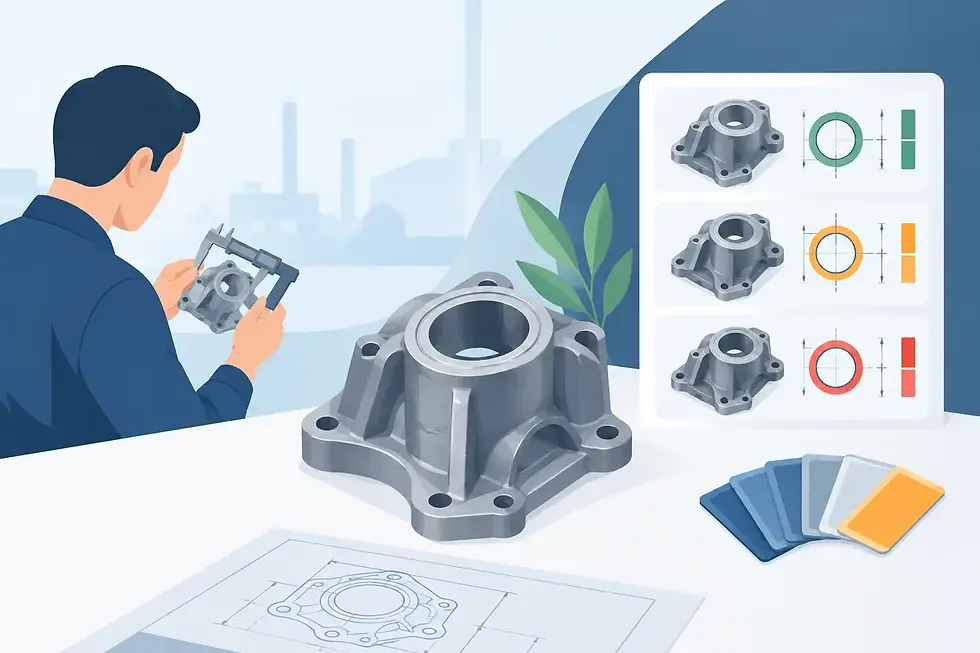
The choice is not always CNC or casting. Many dependable brass components are cast first and CNC machined afterwards. Casting produces the body efficiently; machining then delivers the precise connection points and functional surfaces.
This approach is especially relevant for pressure-handling and fluid-control products. Threads must engage correctly, gasket faces need controlled flatness and bores may require a defined finish. At the same time, the outer form of the valve body or pump housing does not need to be cut from a solid billet.
A hybrid route gives engineers freedom to assign each process to the features it handles best. It can improve material efficiency without compromising the dimensions that affect assembly, sealing or performance.
Quality requirements should decide the process plan
The manufacturing route should be built around the component's service conditions. A decorative brass item and a water-meter body may use similar alloys, but they do not carry the same acceptance criteria. Pressure rating, corrosion resistance, machinability, wall thickness, thread standard and traceability all influence the right process.
For cast parts, quality control may include alloy verification, visual examination, dimensional inspection, weight checks and, where specified, pressure testing or non-destructive testing. Machined parts require material traceability, first-off inspection, in-process checks and verification of critical dimensions. The inspection plan should reflect the actual risk, not add cost without improving confidence.
Clear drawings are central to both routes. They should identify material grade, tolerances, thread standards, surface requirements, pressure-test conditions and any prohibited defects. If a dimension is critical to fit or sealing, it should be marked accordingly. If an as-cast surface is acceptable, that should be equally clear.
A practical sourcing decision
Choose CNC machining when quantities are low, changes are likely, tolerances are demanding across much of the part, or speed to sample matters most. Choose brass casting when the design is proven, volume is sufficient, geometry creates excessive machining waste, and the programme can absorb tooling development.
For many OEM components, the better answer is cast-and-machined production. It balances the cost advantage of a near-net brass casting with the precision needed for threads, interfaces and sealing features.
Tan Tasa UK supports this type of decision with practical manufacturing input, helping buyers assess drawings, expected volumes and inspection requirements before a process is committed. The most economical component is not simply the cheapest item on the first order; it is the one that continues to meet specification, production schedules and cost targets throughout its service life.


Comments