

Choosing an Industrial Bronze Valve Supplier
A valve that performs well on a drawing but fails after repeated pressure cycles creates costs far beyond its unit price. For procurement teams and OEM engineers, selecting an industrial bronze valve supplier is therefore a material, manufacturing and supply-chain decision - not simply a catalogue comparison. The right partner must deliver consistent alloy quality, accurate machining, dependable sealing performance and the capacity to keep pace with production demand.
Bronze remains a trusted valve material for water, pumping, fire protection and general industrial duties because it combines corrosion resistance with strength and machinability. However, the performance of a finished valve depends on far more than calling a component “bronze”. Alloy control, casting integrity, thread accuracy, assembly discipline and final inspection all affect the service life of the part.
What a reliable industrial bronze valve supplier should control
A dependable supplier manages the process from raw material through to packed product. This gives buyers greater confidence that every production batch will meet the same agreed standard, particularly where valves are installed in safety-critical or difficult-to-access systems.
Material selection is the first requirement. Different bronze grades offer different balances of corrosion resistance, mechanical strength, wear performance and cost. A valve intended for potable or non-potable water, for example, may require a different alloy approach from a component used in pumping equipment, marine-adjacent environments or fire hose connections. The supplier should be able to work from a defined material specification and verify that incoming and cast material is suitable for the application.
Casting quality matters equally. Internal porosity, shrinkage defects or inconsistent wall thickness can compromise pressure containment and machining results. Good foundry practice, controlled moulding, appropriate gating and careful finishing reduce these risks before a valve body reaches the machining stage. Buyers should look for a supplier that treats casting and machining as connected processes rather than separate operations.
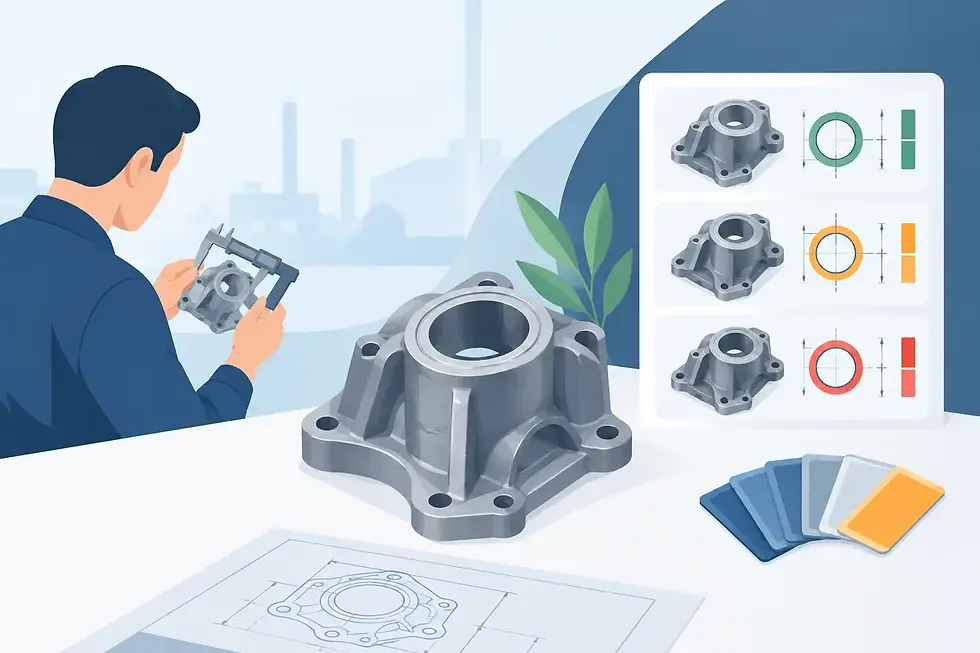
Machining determines whether the valve interfaces correctly with the wider system. Threads, bore dimensions, seating faces and connection geometry need to be held within specified tolerances. A bronze valve may look acceptable externally while still creating installation problems if threads bind, ports are undersized or sealing surfaces are uneven. Consistent CNC machining and in-process checks are central to avoiding these issues.
Assess the supplier beyond the product sample
A first-off sample is useful, but it does not prove that a factory can repeat the same result across thousands of parts. Industrial buyers need to assess process capability, not only the appearance of a single valve.
Confirm inspection methods and documentation
The level of inspection should match the application and purchase specification. For standard industrial valves, dimensional checks, visual inspection, thread verification and functional testing may be appropriate. For more demanding applications, pressure testing, material certification, traceability or customer-specific inspection plans may also be required.
The practical question is not whether a supplier claims to have quality control. It is whether the team can explain what is checked, when it is checked and how non-conforming parts are isolated. Clear records help purchasing teams manage claims, support incoming inspection and maintain confidence as volumes grow.
Test communication as part of qualification
Technical communication often exposes supplier capability early. A good manufacturing partner asks useful questions about pressure range, connection standard, media, operating temperature, surface finish and annual demand. These details influence material choice, tooling, machining time and inspection requirements.
Vague quotations can hide later problems. If drawings are incomplete or a requested requirement conflicts with standard production practice, the supplier should identify the issue before manufacture begins. This is especially valuable for OEM parts, where a small design change can improve manufacturability, reduce scrap and lower the finished cost without affecting function.
Review capacity and lead-time discipline
Production capacity is not just about the largest monthly number a factory can quote. It concerns access to casting capacity, machining cells, assembly resources, inspection staff and export packing. A supplier with controlled planning can support forecast orders, repeat releases and urgent replenishment without allowing one requirement to disrupt the rest of the programme.
Lead times should also be discussed in practical terms. Tooling development, sample approval, first production and repeat production each have different timings. Buyers benefit from a supplier that separates these stages clearly and gives realistic commitments rather than optimistic estimates.
Standard valves versus custom OEM production
Standard bronze valves can be the right commercial choice where the connection type, dimensions and operating duty align with an established design. They usually offer shorter development time and lower initial cost, particularly for replacement parts or distributor stock.
Custom production becomes more valuable when the valve must fit a specific pump assembly, meter housing, fire protection product or machinery system. An OEM design can combine multiple functions in one casting, use a required thread profile, accommodate a defined seal arrangement or meet installation space limits. The trade-off is that custom work may require pattern or tooling investment, engineering review and sample approval before volume manufacture.
The best industrial bronze valve supplier will be able to support both routes. This gives buyers a practical choice: source an established component where it fits, or develop a purpose-built part where standard products introduce compromise. It also reduces the administrative burden of managing separate suppliers for catalogue items and specialised components.
Cost should be measured over the supply cycle
A low unit price is meaningful only when the valve arrives on time, matches the specification and performs in service. Rejected parts, rushed replacement orders, delayed assemblies and field failures can quickly outweigh an initial saving.
The most competitive supply arrangement balances factory efficiency with process control. Vietnam-based manufacturing can provide a strong cost position for cast and machined bronze components, particularly at repeat production volumes. Yet offshore production works best when it is paired with responsive commercial communication, clear technical control and export-ready logistics.
Tan Tasa UK combines a UK commercial point of contact with manufacturing capacity in Vietnam, supporting buyers who need competitive pricing without losing access to practical engineering and order support. For purchasers, this model can simplify communication while retaining the scale benefits of established overseas production.
When comparing quotations, consider the full scope: alloy grade, machining operations, seals and handles where applicable, testing, finish, packing, documentation, tooling and shipment terms. A detailed quotation makes it easier to compare like for like and prevents an apparently cheaper offer from becoming more expensive after exclusions are added.
Questions worth asking before placing an order
Before approving a new valve source, buyers should establish whether the supplier can manufacture to the required bronze grade and dimensional standard, carry out the agreed inspection and testing, and maintain consistency across repeat batches. Ask how engineering changes are controlled, what happens when a non-conformance is found, and whether samples will be produced from production-intent tooling and processes.
It is also sensible to discuss packaging early. Bronze valve bodies can be damaged by thread contact, poor separation or insufficient corrosion protection during long-distance transport. Export packing should protect machined surfaces and allow straightforward identification at goods-in. For distributors, labelling and carton quantities may matter just as much as the component itself.
Finally, assess the supplier’s willingness to plan ahead. A manufacturing partner that understands forecast demand, safety-stock requirements and seasonal pressure can help prevent avoidable shortages. This is particularly relevant in water infrastructure, fire protection and pump manufacturing, where delayed components can hold up higher-value finished assemblies.
Build the relationship around repeatability
Bronze valves are often specified for long service, but the sourcing decision should be judged over repeated orders rather than one purchase. The most useful supplier is one that can preserve material, dimensions, performance and communication standards as demand changes.
Start with clear specifications, agree inspection expectations, and use sample approval to resolve questions before full production. Once the process is proven, a capable manufacturing partner becomes more than a source of valves - it becomes a practical part of your production planning, helping you protect quality while keeping component costs under control.


Comments