

Bronze Pump Parts vs Cast Iron: Which Lasts?
A pump can meet its flow and pressure target on paper, yet fail early because the wetted materials do not suit the liquid. That is the practical issue behind bronze pump parts vs cast iron. The better choice depends on water chemistry, temperature, operating hours, abrasive content, repair expectations and the true cost of a shutdown.
Cast iron remains a widely used pump material because it is economical, strong and easy to produce in substantial housings. Bronze costs more per kilogram, but it often earns its place in components exposed to corrosive water, frequent wet-dry cycles or close-tolerance moving surfaces. For OEMs and maintenance buyers, the decision should be based on duty rather than a simple preference for one metal.
Bronze Pump Parts vs Cast Iron in Service
The key distinction is how each material reacts to its environment. Cast iron performs well in many clean, neutral-water duties, particularly where the pump remains flooded and corrosion control is managed. It offers good compressive strength, vibration damping and cost efficiency for bodies, casings and structural parts.
Bronze is a copper-based alloy, normally selected for its corrosion resistance, machinability and reliable behaviour in water-handling applications. Bronze impellers, wear rings, bushes, valve elements and fittings are common where component condition has a direct effect on hydraulic efficiency or sealing performance.
Neither material is universally superior. A cast iron casing paired with a bronze impeller is often an effective, commercially sensible arrangement. Conversely, specifying bronze throughout a pump used only for clean closed-loop water may add cost without extending service life enough to justify it.
Corrosion resistance and water quality
This is often the deciding factor. Unprotected grey cast iron can form rust when exposed to oxygenated water. Surface corrosion may be tolerable on a heavy casing, but it can become a serious problem when it affects mating faces, narrow waterways, threaded connections or precision clearances. Coatings help, but coating condition must be maintained and any damaged area can become a starting point for further corrosion.
Bronze generally offers much better resistance in fresh water and many marine or brackish-water duties. It develops a stable surface film rather than the expansive rust associated with iron. This can reduce seized fasteners, preserve passages and help maintain the dimensions of critical components over time.
However, “bronze” is not a complete material specification. Aluminium bronze, tin bronze and leaded bronze each have different mechanical, wear and corrosion characteristics. Chloride concentration, pH, dissolved oxygen, water velocity and galvanic contact with other metals all need consideration. In aggressive seawater or high-velocity conditions, the alloy grade and casting quality matter as much as the decision to use bronze.
Wear, abrasion and moving parts
For clean-water centrifugal pumps, corrosion is frequently the main concern. In slurry, sediment-laden water or process fluids carrying solids, abrasion may dominate instead. Standard bronze is not automatically the best answer for abrasive duty, and a hard iron, duplex stainless steel, coated component or specialist alloy may be more suitable.
That said, bronze is highly effective in many bearing and rubbing applications. Bronze bushes can provide good anti-friction behaviour, tolerate boundary lubrication better than many materials and run well against compatible shafts. Bronze wear rings are also valued where consistent machining and stable clearances support pump efficiency.
Cast iron has good wear resistance in appropriate grades and is commonly used for pump bodies and certain internal components. Its limitation is brittleness relative to some alternatives. Impact, thermal shock, poor installation alignment or pipe strain can create cracking risks that should be considered for large cast components.
Cost Should Be Measured Over the Pump’s Life
Initial purchase price strongly favours cast iron in most standard applications. Iron is readily cast, widely available and cost-effective for high-volume production. For general building services, agricultural transfer and closed-system circulation, this makes it a rational choice.
The price comparison changes when replacement intervals, labour and lost operating time are included. If a corroded impeller reduces output, a seized bronze-free bush damages a shaft, or a rusted casing needs premature replacement, the material saving at purchase can disappear quickly. This is especially relevant for fire protection equipment, remote installations, water infrastructure and OEM units where field service is expensive.
Procurement teams should ask for more than a unit-price comparison. A useful evaluation considers expected operating life, spare-part availability, compatibility with existing assemblies, inspection requirements and the consequence of failure. A lower-cost cast iron part may be the right decision when it is easily accessible and non-critical. A bronze component may be the stronger commercial decision when reliability protects a high-value system.
Manufacturing and dimensional control
Material selection also affects how parts are manufactured. Cast iron is well suited to large, complex castings, but machining surfaces accurately after casting is essential where sealing faces, bearing bores and impeller fits are involved. Foundry process control, chemical composition and inspection discipline all influence final performance.
Bronze casts and machines well, making it a practical choice for detailed valve bodies, impellers, bushes, gland components and custom fittings. It can support accurate finishing for parts with tight tolerances. Yet bronze casting requires the same attention to feeding, porosity control, alloy verification and machining allowances as any engineered component.
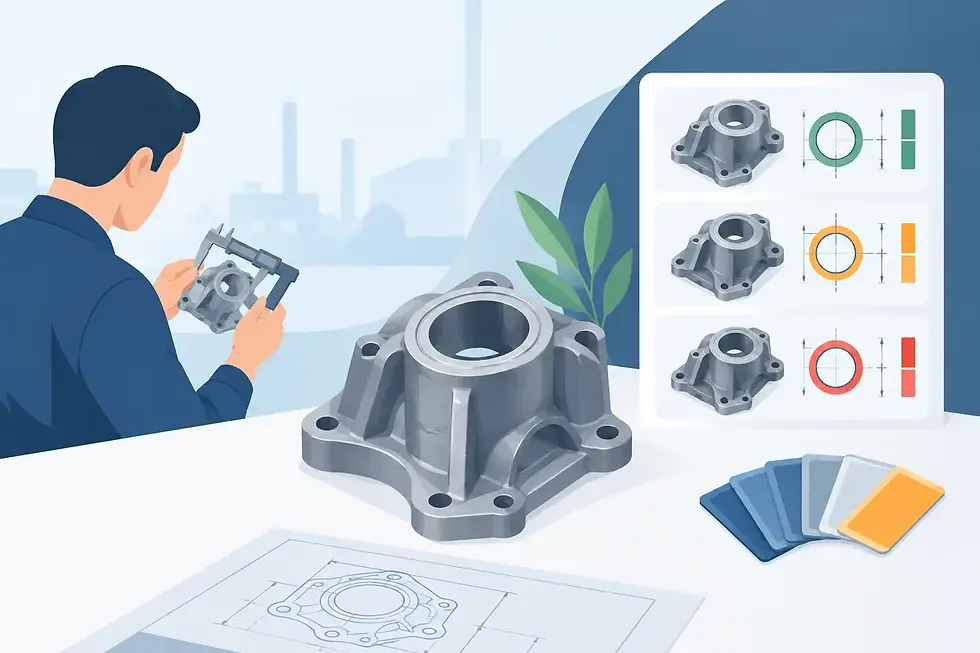
For OEM supply, a drawing should identify the exact alloy standard, heat-treatment requirement where applicable, critical dimensions, surface finish, pressure duty and inspection criteria. Calling for “bronze” or “cast iron” alone leaves too much room for variation. The right supplier should be able to review the application, recommend a grade and produce inspection records matched to the component’s risk level.
Where Each Material Makes Sense
Cast iron is usually a sound fit for pump casings handling clean or treated water, especially in indoor, controlled or closed-loop systems. It is also appropriate where casing wall thickness, structural stiffness and competitive pricing matter more than long-term external corrosion resistance. Protective coatings and suitable storage conditions improve its performance further.
Bronze is commonly justified for impellers and wetted components exposed to raw water, variable water quality, brackish conditions or recurring moisture. It is particularly useful in pump designs where corrosion damage would affect flow, balancing, clearances or service access. Bronze is also a practical material for bushes, valve parts and fittings requiring dependable machining and resistance to seizure.
A mixed-material construction is often the most efficient design. For example, a cast iron volute can provide strength and economical mass, while a bronze impeller and wear components protect the areas most exposed to corrosion and dimensional wear. This approach avoids paying for premium alloy where it offers limited benefit while improving durability where it matters.
Questions to Settle Before Specifying
Before finalising a material, engineering and purchasing teams should establish the liquid composition, including chloride level, solids content, pH and temperature range. They should also confirm whether the pump is continuously immersed, intermittently used or left wet during long standby periods. These conditions can change the corrosion risk considerably.
It is equally useful to review the pump’s service model. Can a component be replaced quickly from local stock? Is the unit installed in a difficult location? Does a reduction in output create a safety, compliance or production problem? The answers determine how much value should be assigned to longer material life.
Finally, check compatibility across the full assembly. Bronze, cast iron, stainless steel, brass and aluminium can create galvanic concerns when electrically connected in conductive water. Correct material pairing, isolation where needed and suitable fasteners are part of a durable design, not secondary details.
For buyers seeking a cost-effective answer, the best specification is rarely simply bronze or cast iron. It is the combination of alloy, casting method, machining accuracy and inspection level that matches the pump’s actual duty. Tan Tasa UK can support that process with standard or custom copper-alloy components produced to defined drawings and quality requirements.


Comments