

Top Inspection Methods for Castings
A casting can look acceptable on the pallet and still fail once it reaches machining, pressure testing or final assembly. That is why the top inspection methods for castings matter well before parts leave the foundry. For buyers of brass, bronze and copper alloy components, inspection is not a box-ticking exercise. It is one of the clearest indicators of whether a supplier can deliver repeatable quality at production scale.
In practice, no single inspection method is enough. Surface flaws, internal porosity, dimensional drift and alloy variation all show up in different ways. The right approach depends on the part geometry, the material, the end-use risk and the commercial reality of the order volume. A water meter body, valve component or pump fitting may require a different inspection mix from a decorative or non-critical casting.
Why the top inspection methods for castings are used together
Foundry inspection works best as a layered process. Visual checks catch obvious issues quickly and at low cost. Dimensional inspection confirms that the part will fit and function. Non-destructive testing helps identify hidden defects without scrapping good product unnecessarily. Material verification supports compliance and long-term performance.
For procurement teams, this matters because quality failures rarely appear in isolation. A part with acceptable dimensions may still contain internal shrinkage. A clean-looking surface may hide cracks near stressed sections. An efficient supplier understands where each method adds value and where extra inspection offers little practical return.
Visual inspection
Visual inspection is the first gate and still one of the most useful. It identifies readily visible defects such as misruns, cold shuts, excessive flash, surface porosity, dents, inclusions and obvious damage from handling. On copper alloy castings, it can also highlight surface finish issues that may affect machining or plating.
Its strength is speed. Large batches can be screened quickly, and reject conditions can be standardised using approved samples, photographs or defect criteria. For higher-volume orders, visual inspection is often built directly into production flow rather than treated as a separate activity.
Its limitation is equally clear. Visual inspection only shows what can be seen. It does not verify internal soundness, exact geometry or metallurgical conformity. Used on its own, it gives a false sense of security.
Dimensional inspection
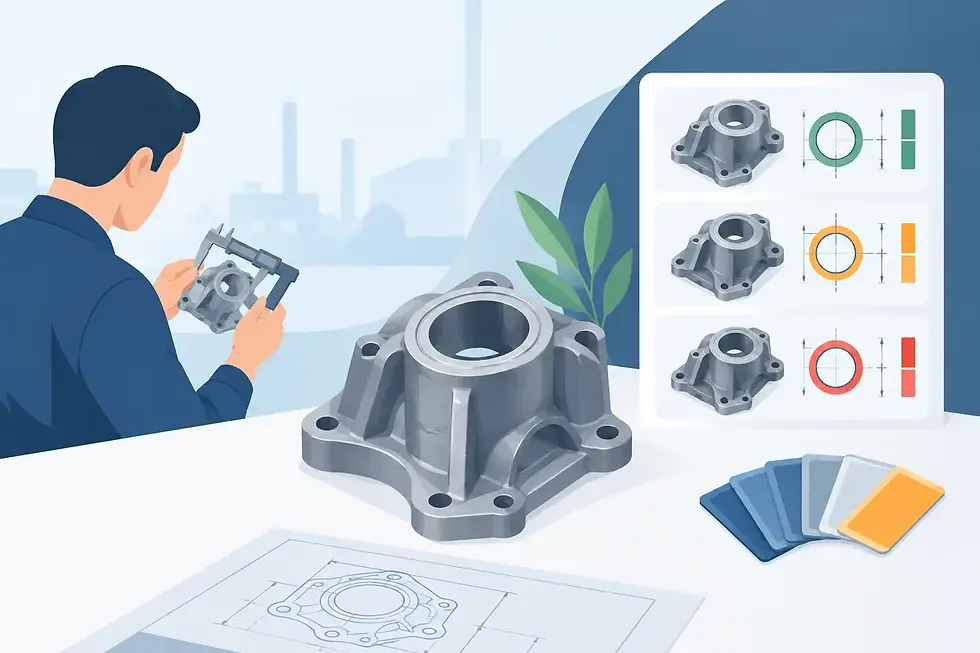
For OEM and industrial parts, dimensional control is usually where commercial risk becomes very obvious. If the casting is out of tolerance, assembly slows down, machining allowances disappear or sealing performance is compromised. That is why dimensional inspection is central to the top inspection methods for castings, especially for valve bodies, pipe fittings, pump parts and threaded components.
Basic dimensional checks may use callipers, micrometres, plug gauges, thread gauges and height gauges. These methods are practical and cost-effective for routine production. For more complex geometries, coordinate measuring machines provide a much more complete picture. CMM inspection is particularly useful where multiple datums, internal features or tight positional tolerances must be confirmed.
There is a trade-off here. Full CMM inspection on every part is rarely commercially sensible for standard volume production. A smarter approach is often first article approval, in-process checks at defined intervals and final sampling based on risk. This keeps inspection aligned with both cost and functional requirements.
Chemical composition testing
A casting that meets size and appearance requirements can still fail in service if the alloy is wrong. Chemical composition testing confirms that the material matches the specified grade and that key elements remain within acceptable limits. For brass, bronze and copper alloys, even relatively small variations can affect corrosion resistance, machinability, pressure performance and mechanical strength.
Spectrometry is commonly used for this purpose. It provides fast and reliable analysis of alloy composition and helps prevent material mix-ups in production. This is especially important when a supplier manufactures multiple copper alloy grades for different applications.
From a buyer's perspective, composition testing is not only a quality issue but also a compliance issue. If your component must meet a recognised standard or perform in a regulated application, material verification should be treated as essential rather than optional.
Mechanical property testing
Mechanical testing checks whether the casting can withstand service conditions. Depending on the application, this may include tensile strength, hardness, elongation or impact performance. Not every casting programme needs extensive mechanical testing, but critical parts often do.
This method is most valuable when linked to material grade, process stability and end-use demands. A fire protection component, pressure-bearing part or safety-relevant fitting usually justifies stricter validation than a non-critical housing. In many cases, periodic test bars or representative samples provide enough confidence without creating unnecessary cost on every batch.
The key point is that mechanical testing verifies performance, not just appearance. For engineering and sourcing teams, that distinction matters.
Dye penetrant inspection
Dye penetrant inspection is a practical non-destructive method for finding fine surface-breaking defects. A penetrant liquid is applied to the casting surface, allowed to enter any cracks or discontinuities, then drawn back out with a developer to make flaws visible.
This method is particularly useful on non-ferrous castings where small cracks may not be obvious during normal visual inspection. It is often used on machined areas, sealing faces or sections expected to see stress in service.
However, dye penetrant only reveals defects open to the surface. It will not detect deeper internal voids or subsurface cracking. Cleanliness is also important, as contamination can affect results. It is a targeted method rather than a universal one.
Pressure testing and leak testing
For valves, meter bodies, pump components and fluid-handling parts, pressure testing is often one of the most commercially relevant checks. A component can pass visual and dimensional inspection yet still fail because of porosity or leakage paths within the casting wall.
Hydrostatic testing is widely used to confirm pressure integrity. Air leak testing may also be applied depending on the product and specification. These tests simulate service conditions more directly than many other inspection methods and give buyers confidence that the casting will perform in the field.
The practical question is test coverage. Some products justify 100 per cent pressure testing, particularly where failure in service would be expensive or safety-critical. In other cases, sample-based validation may be enough if the process is mature and defect rates are well controlled.
Radiographic inspection
Radiographic testing, often using X-ray, is one of the most effective ways to detect internal defects such as shrinkage cavities, gas porosity and inclusions. For castings with thick sections or critical pressure-bearing zones, it can reveal issues that no surface method can detect.
Its value is high, but so is the cost relative to simpler checks. That means it is usually reserved for higher-risk parts, customer approval samples or applications where internal soundness is essential. It is not always necessary for routine commodity castings, but for critical OEM components it can be a decisive part of the inspection plan.
Radiography also requires trained interpretation. Images need to be assessed against agreed acceptance criteria. Without that discipline, the test itself does not guarantee consistent decision-making.
Ultrasonic testing
Ultrasonic inspection uses high-frequency sound waves to detect internal discontinuities and wall thickness variation. It can be useful for larger castings or sections where internal integrity matters but full radiographic inspection may be less practical.
That said, ultrasonic testing is more sensitive to geometry, surface condition and operator skill. On small, complex copper alloy castings, results can be more difficult to interpret than on simpler shapes. It is a strong option in the right application, but not the default choice for every casting programme.
Choosing the right inspection plan
The best inspection regime is driven by function, not by habit. If a casting will be machined heavily, dimensional allowance and internal soundness deserve close attention. If it is pressure-bearing, leak testing moves up the list. If it sits in a corrosive environment, material verification becomes more important. If production volume is high, process control and sampling discipline matter just as much as the individual test method.
Experienced suppliers build inspection around the actual risk profile of the part. They also understand the commercial balance. Over-inspection increases cost and lead time. Under-inspection pushes problems downstream, where they become far more expensive.
For that reason, buyers should look beyond a supplier simply listing test capabilities. The more useful question is whether inspection is planned logically, recorded clearly and applied consistently across batches. At Tan Tasa UK, that is the standard serious industrial buyers should expect from any manufacturing partner.
The strongest casting supply relationships are built on predictable quality, not inspection theatre. When inspection methods are chosen for the part, the process and the real service conditions, they do more than find defects. They reduce waste, protect delivery schedules and give engineering and procurement teams fewer unpleasant surprises after the goods arrive.


Comments