

Choosing a Brass Valve Manufacturer UK
When a valve fails in service, the problem rarely stays confined to one component. It affects assembly schedules, field performance, warranty exposure and, in some sectors, compliance risk. That is why choosing a brass valve manufacturer UK buyers can rely on is not simply a purchasing decision. It is a supply-chain decision with direct engineering and commercial consequences.
For OEMs, distributors and procurement teams, the question is not who can quote the lowest unit price on paper. It is who can supply the right valve, to the right specification, at the right volume, with quality controls that hold up over time. In practice, that means looking beyond catalogue claims and testing whether a manufacturer can support repeatable production, custom requirements and consistent communication.
What buyers should expect from a brass valve manufacturer UK
A credible manufacturer should offer more than a product list. Buyers need evidence of process discipline, material control and production capability. Brass valves are used in applications where leakage, corrosion resistance, dimensional accuracy and thread consistency all matter. If any of those variables drift, the downstream cost can quickly outweigh an attractive headline price.
At a minimum, a supplier should be able to explain how raw materials are controlled, how machining tolerances are maintained and how finished valves are inspected before dispatch. That applies whether you are sourcing standard shut-off valves, non-return valves, bibcocks, meter valves or parts built to an OEM drawing. The technical detail does not need to be overstated, but it does need to be clear.
A UK-facing supplier should also offer practical accessibility. For many buyers, local commercial support matters because it reduces delays in quotation, clarifies specifications and gives procurement teams a direct point of contact when projects move quickly. That commercial visibility becomes especially valuable when orders involve mixed product ranges or design modifications.
Price matters, but only in context
Industrial buyers are right to focus on cost. Brass valve sourcing is often highly competitive, and margin pressure is real across plumbing, water, fire protection and machinery markets. But low pricing only has value if the product arrives on time and performs as specified.
This is where buyers need to separate cheap from cost-efficient. Cheap usually appears in the quote and disappears in the claim rate, the rework bill or the missed delivery. Cost-efficient sourcing, by contrast, combines sensible pricing with stable manufacturing standards. A manufacturer with scale production, disciplined inspection and proven export processes can often deliver lower overall cost even if the initial unit figure is not the absolute minimum in the market.
That trade-off is particularly relevant when comparing purely domestic production with hybrid sourcing models. UK buyers often want the responsiveness of a local contact but the pricing advantages of offshore manufacturing. When managed properly, that model can work well. When managed poorly, it creates communication gaps and uneven lead times. The difference lies in whether the supplier has genuine control over production and quality, rather than acting only as a trader.
Quality control is where supplier claims are tested
Most manufacturers will describe their products as high quality. Serious buyers look for how that quality is achieved.
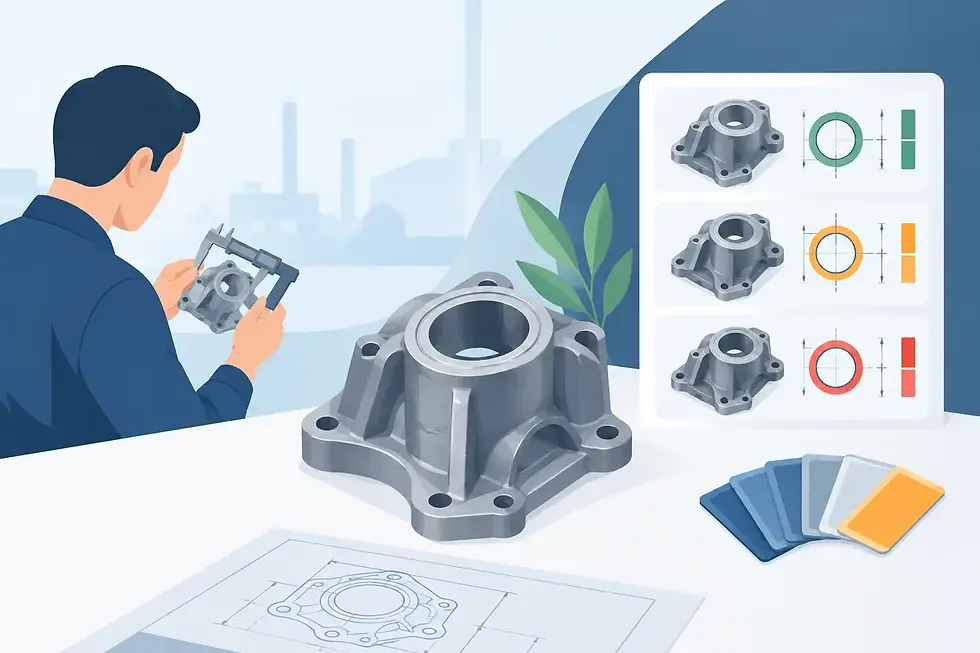
For brass valves, inspection should cover more than visual appearance. Material verification, dimensional checks, pressure testing where applicable, thread accuracy and finishing consistency all contribute to whether a valve performs reliably in service. In larger-volume supply, consistency between batches is often more important than the performance of a single approved sample.
This is why process control deserves close attention. Ask how tooling is maintained, how non-conforming parts are handled and whether inspection is carried out at multiple production stages. A supplier that can discuss these points directly is usually easier to work with than one relying on broad marketing statements.
There is also a practical point here for procurement teams. The more clearly a supplier controls quality upstream, the less burden falls on incoming inspection and internal troubleshooting. That can save time across purchasing, engineering and operations.
OEM capability changes the value of the relationship
Standard valves remain important, but many industrial buyers do not need standard parts alone. They need a supplier that can adapt designs, machine to customer drawings or produce related brass and bronze components alongside valves. That is where OEM capability becomes commercially useful.
A manufacturer with custom production experience can help reduce supplier fragmentation. Instead of buying standard valves from one source, castings from another and machined brass parts from a third, buyers may be able to consolidate more of the requirement with one production partner. That can improve communication, reduce administration and simplify quality oversight.
The key point is not whether every order is bespoke. It is whether the manufacturer has the technical and production flexibility to support specification changes when needed. In sectors such as water metering, pump assemblies, sprinkler systems and industrial equipment, small dimensional or functional changes are common. A supplier that can respond without disrupting lead time or quality becomes more valuable over the life of the account.
Lead times need realistic planning, not optimistic promises
Fast quoting and fast delivery are not the same thing. Buyers should expect both, but they should also expect honesty about what is achievable.
Reliable lead times come from planning capacity, stable supply of raw materials and organised production scheduling. If a supplier cannot explain how orders move from quotation to tooling, machining, inspection and shipment, lead-time promises may be little more than sales language. For repeat orders, the question becomes even more important. Can the manufacturer maintain performance when volumes increase or when demand becomes less predictable?
This is one of the strongest reasons to work with a manufacturing partner rather than a transactional supplier. A partner will plan with the customer, flag pressure points early and keep communication active when schedules shift. That is particularly important for export-oriented buyers managing stock across several markets.
The case for a hybrid UK and offshore model
For many companies, the most practical sourcing structure is neither fully domestic nor fully remote. It is a hybrid model that combines local commercial support with lower-cost, high-volume manufacturing overseas.
When that model is backed by real factory capability, it can give buyers a useful balance of responsiveness and cost control. A UK point of contact helps speed up quotation, resolve technical questions and keep communication straightforward. Offshore production can then support competitive pricing on volume orders without compromising material quality or machining accuracy.
This approach suits buyers who need dependable brass and copper alloy components at scale but do not want to sacrifice access or accountability. It is particularly relevant where orders include a mix of standard valves and OEM parts, or where procurement teams need a supplier that can support growth without forcing a step change in unit cost.
Tan Tasa UK operates in this space, pairing UK commercial access with Vietnam-based manufacturing capacity for brass, bronze and copper alloy components. For buyers, that structure can make sense when the priority is consistent industrial supply, technical support and commercially efficient production rather than a purely domestic label.
How to evaluate a brass valve manufacturer UK buyers can trust
The most useful supplier assessments are usually straightforward. Start with the drawing, the specification and the volume requirement. Then test how the manufacturer responds.
Do they ask sensible technical questions, or do they quote too quickly without clarifying details? Can they support both standard and custom parts? Do they explain inspection processes clearly? Are lead times realistic? Is communication direct and commercially useful? These are practical signals of whether the relationship will hold up once orders move beyond the trial stage.
It also helps to assess product range in context. A supplier with broader experience across valves, castings and machined components may be better positioned to support future sourcing needs. That does not mean the largest catalogue is always best. It means capability should match your likely purchasing pattern.
Finally, consider whether the manufacturer understands your sector. Water systems, fire protection, pumping and machinery applications each bring different demands. A supplier that recognises the service environment, performance expectations and documentation requirements is often easier to integrate into existing procurement processes.
A dependable sourcing decision usually comes down to the same principle: choose the manufacturer that makes your operation easier to run, not just the one that makes the first quote look smaller.


Comments