

Casting Tolerance for OEM Parts Explained
Updated: May 4
A valve body that is 0.3 mm oversized may still pass visual inspection. However, it can fail during assembly, create a leak risk, or necessitate extra machining that was never priced into the job. This is why casting tolerance for OEM parts matters early on, not just after the first batch lands. For engineers and buyers sourcing brass, bronze, and copper alloy components, tolerance is not merely a drawing detail. It directly controls cost, repeatability, lead time, and field performance.
In OEM supply, tolerance decisions sit at the intersection of design intent and factory reality. Set them too loosely, and you invite fit-up problems, inconsistent machining stock, and greater variation between lots. Set them too tightly, and the casting process slows down, scrap rates rise, tooling requires more attention, and unit costs climb. Good sourcing decisions stem from understanding this balance.
What Casting Tolerance for OEM Parts Actually Covers
Casting tolerance refers to the allowable variation between the nominal dimensions on the drawing and the dimensions achieved in production. This includes linear dimensions, wall thickness, hole position, flatness, draft-related variation, and the amount of stock left for later machining.
For OEM parts, this is rarely a single number applied universally. A pump housing, meter body, sprinkler fitting, or custom brass connector may have some surfaces that can accept wider variation, while others must be held closely due to their impact on sealing, thread engagement, or assembly with mating parts. The commercial mistake is treating the entire component as if every feature is equally critical.
A practical tolerance strategy separates cast-as-cast features from machined features. Cast surfaces can often tolerate more variation, provided there is enough machining allowance on critical areas. Machined bores, sealing faces, thread locations, and datum features usually require tighter control because they drive the final fit and function.
Why Tolerance Affects More Than Part Quality
Many buyers initially view tolerance as a quality issue. While it is indeed that, it also relates to pricing and scheduling. Tight tolerances increase process control requirements across the job. Tooling condition becomes more important, mould consistency matters more, and inspection time rises. Process capability must be demonstrated, not merely assumed.
This has a clear cost effect. A foundry can produce a sound brass or bronze casting at a competitive cost. However, if the drawing demands unnecessarily tight limits on non-critical features, the process may require more secondary operations or higher scrap acceptance. Consequently, the part price increases without enhancing performance in service.
Lead time can also move in the wrong direction. Tighter tolerance parts may require more first article checks, additional tool corrections, and more in-process sorting before they are ready for dispatch. For procurement teams managing launch dates or replenishment schedules, tolerance discipline supports supply-chain stability as much as dimensional control.
The Main Factors That Drive Casting Variation
No foundry process produces perfect geometry on every cycle. Variation is inherent in casting, and the goal is to control it within acceptable limits. Several factors shape the final result.
Material behaviour is one of the most significant factors. Brass, bronze, and copper alloys shrink during solidification and cooling, and different alloys behave differently. A tolerance that may be straightforward for one grade can be harder to maintain for another, particularly on thicker or more complex geometries.
Part design also plays a crucial role. Thin walls, deep pockets, long unsupported spans, and abrupt section changes all increase the chance of distortion or inconsistency. The more complex the shape, the more carefully tolerances should be allocated. A simple round fitting can often be held more predictably than a multi-port valve body with intersecting passages and uneven wall sections.
Tooling condition is another practical factor. Over long production runs, wear can gradually change dimensions. This is why disciplined maintenance and scheduled inspection are essential for OEM programmes with repeat orders.
Then there is process selection. Sand casting, gravity casting, die casting, and investment casting each offer different capability levels. There is no universal best option; it depends on part geometry, alloy, annual volume, machining plan, and target cost.
How to Specify Tolerances Without Overengineering the Part
The best OEM drawings do not require the casting supplier to guess what matters. They clearly identify critical-to-function features while allowing reasonable freedom elsewhere. This enables the factory to build a process that protects what affects assembly and performance while keeping the rest commercially efficient.
Start with the function of the part. If a face must seal, specify that clearly. If a bore aligns a moving shaft, make that explicit. If a non-machined outer surface only needs to fit within an enclosure, imposing a premium tolerance band is usually unnecessary.
Datum structure is equally important. If the drawing lacks clear datums, measurements can be taken from different references, leading to disputes that are not truly about manufacturing quality. A good datum scheme ensures consistent inspection and prevents arguments over acceptable parts.
Machining allowance should be specified with care. Too little stock may prevent the machine shop from cleaning up the surface on every casting. Conversely, too much stock adds cycle time, tool wear, and material waste. For many OEM parts, the casting tolerance and the machining plan must be reviewed together, not as separate activities.
This is where early supplier input proves invaluable. An experienced manufacturing partner can often suggest where a tolerance can be relaxed, where more stock is needed, or where a geometry change can improve consistency without altering function. Such discussions typically save money before production starts, when changes are still cost-effective.
Casting Tolerance for OEM Parts and Inspection Planning
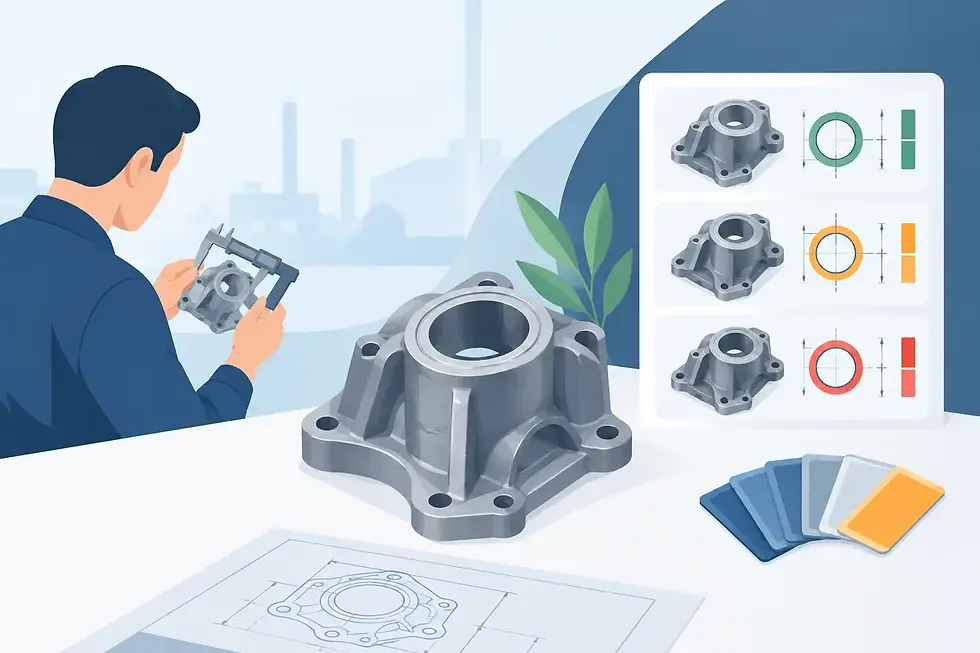
A tolerance is only useful if it can be measured consistently. Inspection planning should align with the actual risk in the component. Critical dimensions require reliable methods, stable fixturing, and agreed acceptance criteria. Less critical features can often be checked through routine sampling rather than intensive measurement of every piece.
For OEM parts, first article inspection is particularly important. It confirms whether tooling, process settings, and machining allowances are working together as intended. If there is drift, it is far better to correct it at this stage than after bulk production has been completed.
Measurement methods also matter. Some dimensions are easy to check with standard gauges or callipers, while others require dedicated fixtures, CMM verification, thread gauges, or pressure testing in later stages. If a drawing includes very tight requirements on features that are difficult to access or inspect, the quality plan becomes slower and more expensive.
The sensible approach is to align inspection intensity with product risk. A decorative external radius on an internal machinery component does not need the same control as a threaded port, sealing land, or pressure-containing wall section.
Common Sourcing Mistakes Buyers Make
One common mistake is copying tolerances from a machined part drawing directly onto a casting drawing. This can create unrealistic requirements and immediate cost inflation. Castings are near-net-shape components, not fully machined billets, and the tolerance framework should reflect that.
Another mistake is failing to distinguish between prototype expectations and mass production capability. A supplier may achieve a dimension on a small sample with extra manual attention, but maintaining that result across high-volume production is a different question. Buyers should inquire about what the process can hold consistently, not just what was achieved once.
There is also a tendency to focus solely on dimensional tolerance while overlooking porosity risk, surface finish expectations, or alloy consistency. For many brass and bronze OEM components, a part can meet size limits and still fail in service if material integrity or machining quality is not controlled to the same standard.
A more effective sourcing review considers the entire route: casting process, alloy selection, tooling design, machining plan, inspection method, and packaging. Tolerance sits within that broader manufacturing system.
Where Tighter Tolerances Are Worth Paying For
There are clear cases where closer control is justified. Sealing faces, bearing locations, threaded interfaces, concentric bores, and assembly datums typically deserve careful specification. Failure in these areas can lead to downstream costs very quickly. The same applies to parts used in pressurised systems, fire protection equipment, pumps, and metering applications, where dimensional stability directly affects function and compliance.
However, even in these cases, not every feature needs to be tightened. A disciplined supplier will assist in distinguishing what must be controlled from what can remain commercially practical. That balance is central to dependable OEM production. Experienced partners add value by translating drawing requirements into a workable manufacturing process rather than merely quoting the print.
For industrial buyers, the real question is not how tight the tolerance can be. It is how tight it needs to be for the part to perform reliably, machine efficiently, and arrive at the right cost. That is the standard worth buying to. When specification, process capability, and inspection are aligned from the start, casting tolerance ceases to be a source of disputes and becomes part of a stable supply programme.


Comments